Table of Contents
Egypt contains a higher concentration of ancient temples than anywhere else on earth. From the colossal complex at Karnak — two thousand years in the making — to the rock-cut sanctuaries of Abu Simbel relocated in the 1960s to save them from rising floodwaters, the temples of Egypt are not simply historical curiosities. They are the physical record of one of the most sophisticated civilizations in human history: its theology, its politics, its art, and its understanding of the cosmos.
For travelers planning Egypt tours focused on ancient monuments, choosing which temples to prioritize is the central planning decision. This guide covers the ten most significant and rewarding — what makes each one distinctive, what to look for when you visit, and how each fits into a broader Egypt travel package.
1. Karnak Temple Complex, Luxor
The Karnak Temple Complex is the largest ancient religious site in the world and, for many visitors, the single most overwhelming experience Egypt offers. Construction began around 2055 BCE and continued for over two thousand years — every pharaoh of consequence added pylons, courts, statues, or obelisks to the complex, making it a layered record of Egyptian history across virtually the entire pharaonic period.
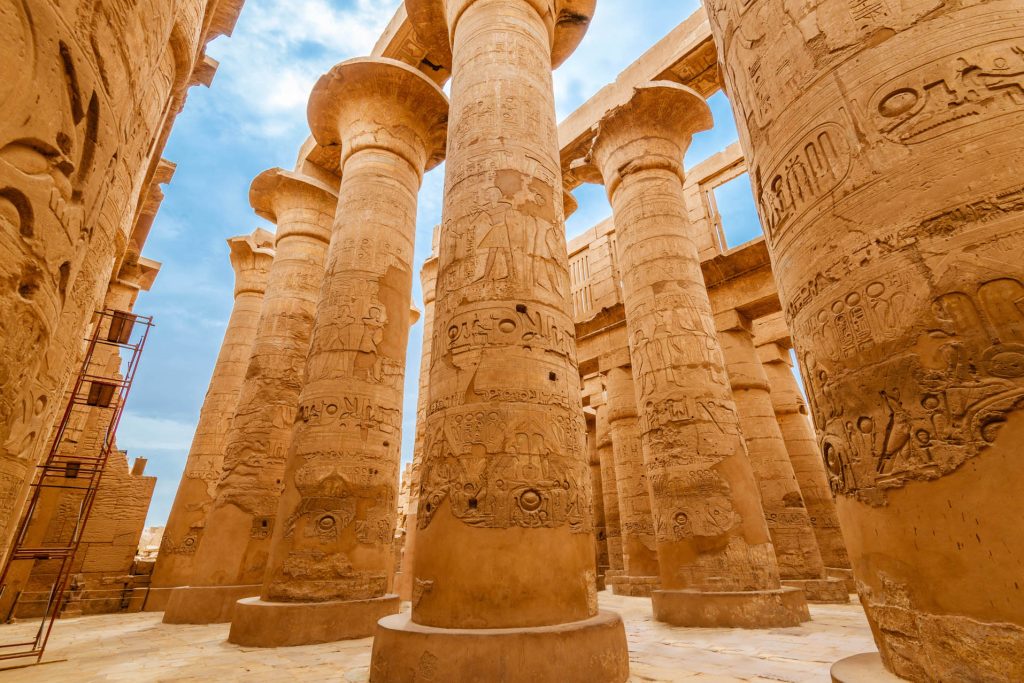
The complex covers over 100 hectares and contains multiple precincts, the most significant being the Precinct of Amun-Ra, which houses the famous Great Hypostyle Hall: a forest of 134 massive columns, some reaching 23 metres in height, every surface covered in painted hieroglyphic reliefs. Walking through this hall for the first time — the columns rising around you in every direction, the scale simply not matching any prior expectation — is one of those experiences that remains with travelers long after everything else about a trip has faded.
The complex also contains the Sacred Lake, several standing obelisks (including the tallest surviving obelisk in Egypt, erected by Hatshepsut), and the beginning of the Avenue of Sphinxes that once connected Karnak to Luxor Temple three kilometres to the south. Allow a minimum of two hours; three is more appropriate for a thorough visit. An evening visit for the Sound and Light Show — walking through the illuminated complex after dark — gives a completely different and equally memorable perspective.
Karnak is a natural centrepiece of any Luxor day tour and one of the defining experiences of a Classic Egypt tour.
2. Abu Simbel Temples, Aswan
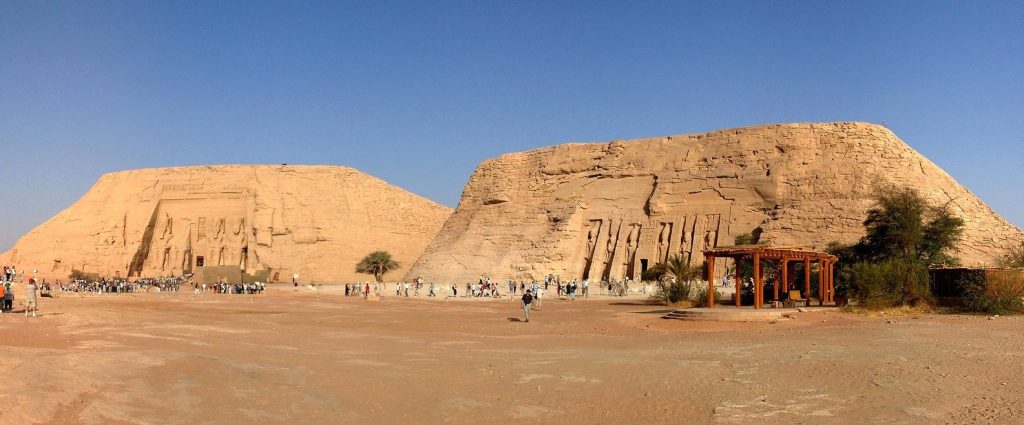
The two rock-cut temples of Abu Simbel, approximately 280 kilometres south of Aswan near the Sudanese border, were commissioned by Ramses II in the 13th century BCE and carved directly into a sandstone cliff above the Nile. The Great Temple — its facade dominated by four colossal seated statues of Ramses II, each approximately 20 metres tall — was designed to project Egyptian power southward into Nubia and to present the pharaoh as a god in his own right, a piece of political theology executed on a monumental scale.
The interior descends through progressively smaller halls to an innermost sanctuary containing four seated statues. Twice a year — on February 22nd and October 22nd — the rising sun penetrates the full length of the temple and illuminates three of the four statues, leaving only Ptah (god of the underworld) in darkness. This solar alignment was replicated with extraordinary precision when the temples were relocated 65 metres higher and 180 metres back during the UNESCO rescue operation of the 1960s — one of the most ambitious engineering projects in the history of heritage conservation.
The smaller Temple of Nefertari, dedicated to Ramses II’s most beloved queen and the goddess Hathor, is unusual in depicting the queen at the same scale as the pharaoh — a rare expression of equality in ancient Egyptian monumental art. Most visitors to Abu Simbel arrive on an Aswan day tour, departing very early in the morning for the three-hour road journey south.
3. Luxor Temple, Luxor
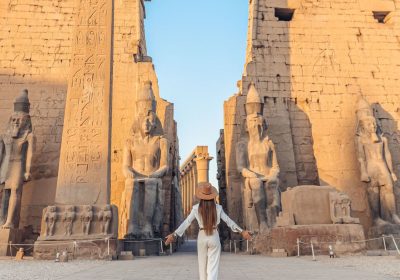
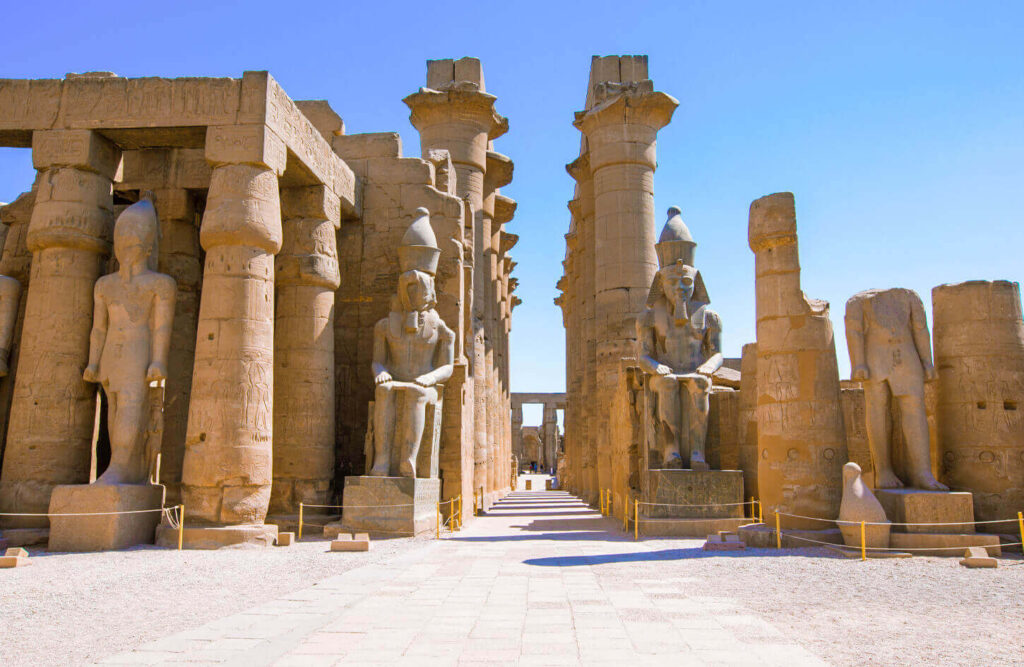
The Luxor Temple sits at the heart of modern Luxor, its entrance pylons and seated colossi of Ramses II visible from the Corniche — one of the most dramatic urban archaeological settings in the world. Built primarily by Amenhotep III in the 14th century BCE and substantially expanded by Ramses II, the temple was dedicated to the Theban Triad of Amun, Mut, and Khonsu and served as the focus of the annual Opet Festival, during which the statue of Amun was carried in procession along the Avenue of Sphinxes from Karnak.
What makes Luxor Temple uniquely fascinating is its layering of history. The Romans built a military fort within its walls in the 3rd century CE; the Copts converted part of it into a church in the early Christian period; and the Abu Haggag Mosque — built in the 13th century CE on accumulated debris that raised the floor level above the ancient columns — still stands within the complex today, its minaret rising from what was once a pharaonic sanctuary. This three-thousand-year continuum of use makes Luxor Temple the most historically layered site in Egypt.
The temple is particularly beautiful at night, when it is illuminated and the crowds thin. If you are spending more than one day in Luxor, an evening visit after a daytime visit to Karnak gives you the same site in an entirely different mood.
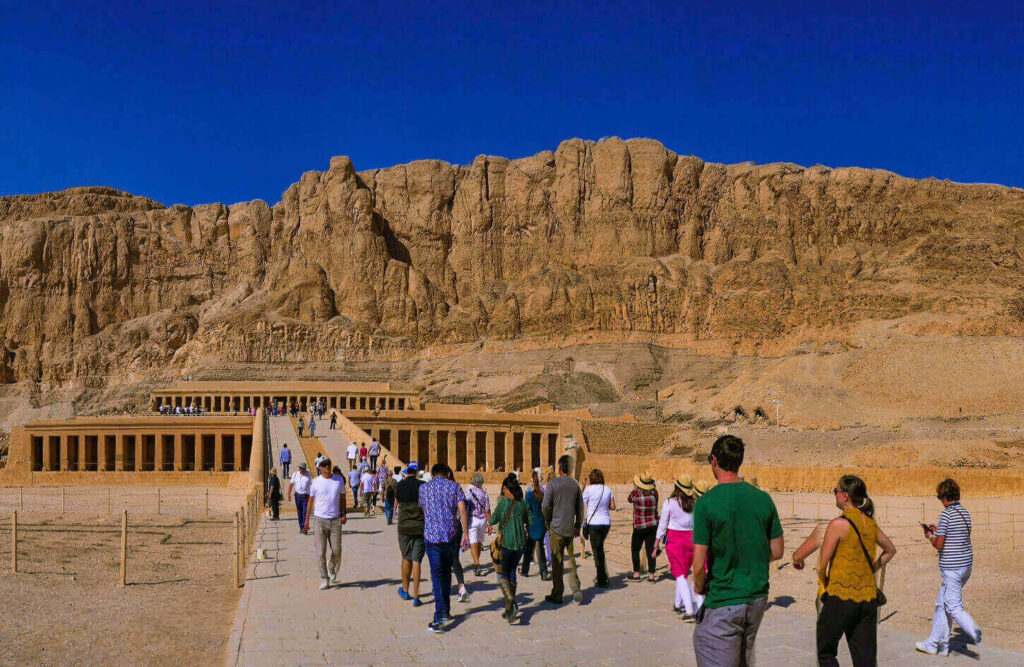
4. Temple of Hatshepsut, Deir el-Bahari, Luxor
The Mortuary Temple of Hatshepsut at Deir el-Bahari is one of the architectural masterpieces of the ancient world. Built in the early 15th century BCE for Hatshepsut — one of ancient Egypt’s rare female pharaohs, who ruled for over twenty years and oversaw some of the most ambitious building projects of the New Kingdom — the temple rises in three colonnaded terraces against the sheer limestone cliffs of the Theban hills, its horizontal lines contrasting dramatically with the vertical rock face behind it.
The temple’s reliefs are among the finest in Egypt: detailed scenes of Hatshepsut’s divine birth (emphasizing her claim to the throne through descent from Amun himself), the famous trading expedition to Punt (believed to be in present-day Somalia or Eritrea), and her coronation. Many of these images were later defaced by her successor Thutmose III in an attempt to erase her from historical memory — an effort that ultimately failed, as modern archaeology has reconstructed her story in remarkable detail.
The site is best visited early in the morning, when the light on the cliffs is at its most dramatic and the temperature is manageable. It is a standard inclusion in any West Bank Luxor tour.

5. Philae Temple, Aswan
The Temple of Isis at Philae is arguably the most beautiful temple complex in Egypt — and certainly the most dramatically situated. Originally built on Philae Island in the Nile south of Aswan, it was dismantled block by block and relocated to the nearby Agilkia Island between 1972 and 1980 as part of the same UNESCO campaign that saved Abu Simbel, to protect it from the rising waters of Lake Nasser. The relocation preserved not just the buildings but their relationship to the water — arriving at Philae by boat, as visitors still do today, gives the approach the same quality it would have had in antiquity.
The temple complex is dedicated primarily to the goddess Isis, with additional shrines to Osiris, Horus, and Hathor. Construction spans the Ptolemaic and Roman periods (roughly 380 BCE to 300 CE), making it one of the last temples built in the classical Egyptian style — and one of the last active sites of ancient Egyptian religion, which continued to be practiced at Philae by a devoted community until the 6th century CE, long after Christianity had become the official religion of the Roman Empire.
Philae is typically combined with a visit to the Aswan High Dam in a single day — the Day Tour to Philae Temple and Aswan High Dam is one of the most popular Aswan tours for good reason. An evening visit for the Sound and Light Show at Philae Temple — experienced from a boat on the water, with the illuminated temple reflected in the Nile — is one of Egypt’s most atmospheric after-dark experiences.
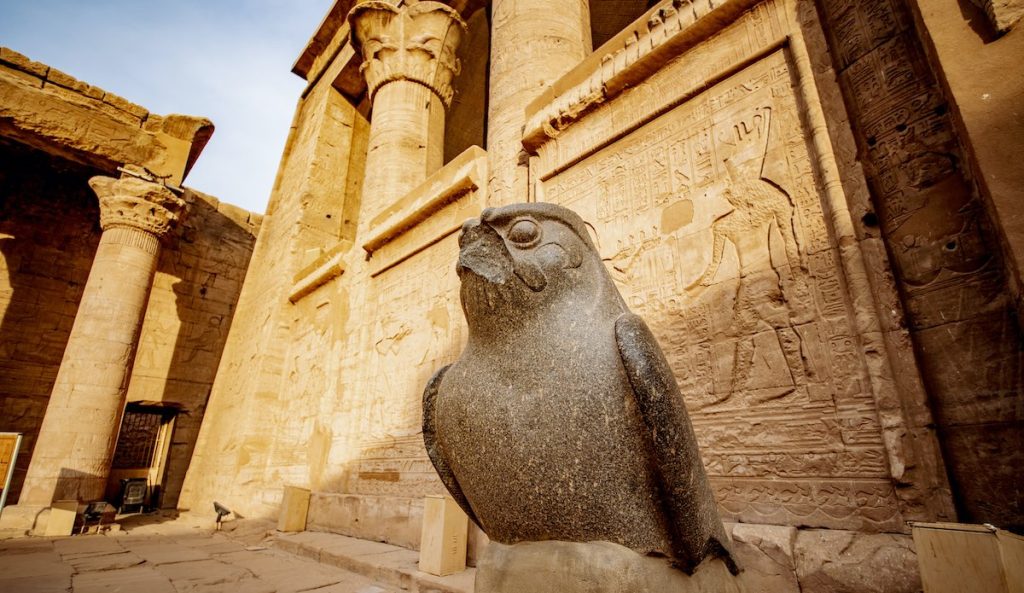
6. Temple of Edfu
The Temple of Edfu, dedicated to Horus the falcon god, is the best-preserved ancient temple in Egypt — and the visit gives the clearest available impression of what a fully functioning ancient Egyptian temple would have looked like from the outside: massive enclosure walls, towering entrance pylons decorated with enormous relief carvings, and a pylon gateway that still stands to its original height of 36 metres. Construction began in 237 BCE under Ptolemy III and took nearly 200 years to complete, meaning that the temple was being finished just as Rome was consolidating its control over Egypt.
Inside, the sequence of courts, hypostyle halls, and sanctuary chambers is complete and largely intact, allowing visitors to trace the progression from public space to increasingly restricted sacred areas — understanding the spatial logic of an ancient Egyptian temple in a way that the more fragmentary sites at Karnak and Luxor do not always permit. The temple walls contain extensive hieroglyphic texts — including a complete version of the Myth of Horus, the story of his conflict with Seth — making Edfu one of the most important sources for ancient Egyptian mythology.
Edfu is most commonly visited as part of a Nile river cruise between Luxor and Aswan, or as part of the Day Trip to Kom Ombo and Edfu Temples from Aswan.
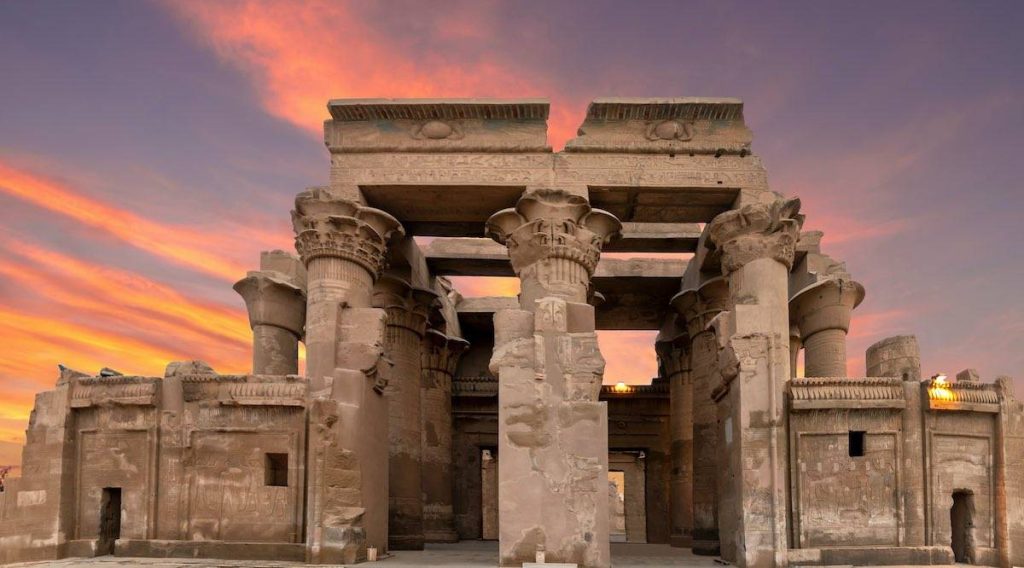
7. Kom Ombo Temple
The Temple of Kom Ombo is unique in Egyptian architecture: a perfectly symmetrical double temple, with two complete sanctuaries, two hypostyle halls, and two sets of ritual spaces built side by side along a shared central axis. The southern half is dedicated to Sobek, the crocodile god associated with fertility and the Nile; the northern half to Horus the Elder. The dual dedication reflects the theology of a site where two powerful local cults co-existed, and the architectural solution — building two temples in one — is elegant and unusual.
The temple’s walls contain some of ancient Egypt’s most remarkable carved reliefs. A famous panel depicts what appear to be surgical instruments — scalpels, forceps, and bone saws — suggesting the temple had a medical function, possibly connected to the healing cult of Imhotep. An attached Crocodile Museum displays dozens of mummified crocodiles found in a cache near the temple, some over two metres long, which were offered as votive gifts to Sobek.
Kom Ombo sits directly on the Nile bank and is particularly beautiful in the late afternoon, when the low light catches the relief carvings on the outer walls. It is a standard stop on all Egypt Nile cruises between Luxor and Aswan.
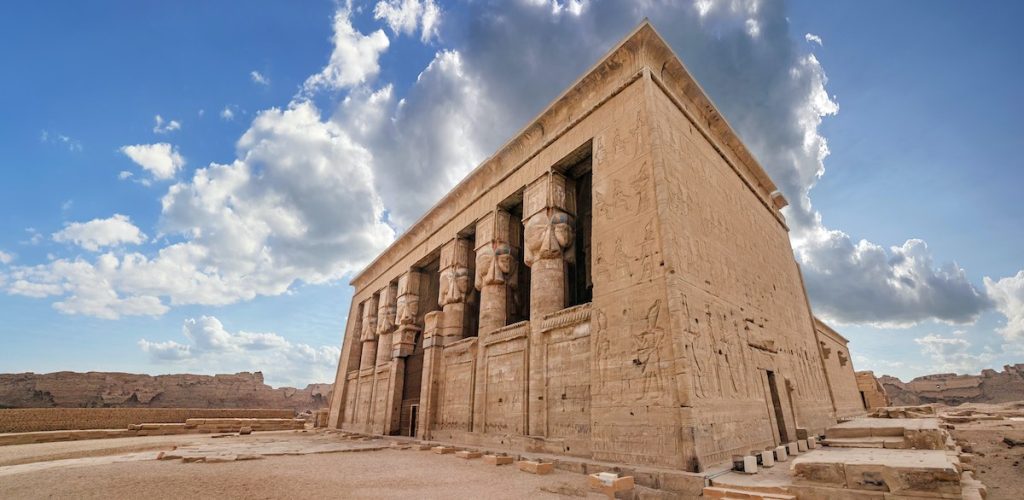
8. Dendera Temple Complex
The Dendera Temple Complex, on the west bank of the Nile north of Luxor, is one of the best-preserved temple complexes in Egypt and one of the least visited by mainstream tourism — which makes it particularly rewarding for travelers who seek it out. The main temple is dedicated to Hathor, goddess of love, music, and beauty, and was built primarily during the Ptolemaic period with Roman additions completed as late as the 1st century CE.
The temple is famous above all for its Zodiac ceiling — a circular bas-relief astronomical map of the heavens that is one of the most significant scientific documents to survive from the ancient world. The original is now in the Louvre in Paris; a painted replica fills the ceiling at Dendera. The temple also contains a remarkable roof chapel dedicated to the resurrection of Osiris, accessed by a steep staircase, with vivid relief carvings that tell the story of Osiris’s death and rebirth in extraordinary detail.
Dendera is most commonly visited as a day trip from Luxor, paired with Abydos — the Tour to Dendera and Abydos from Luxor combines two of Upper Egypt’s most significant and least-crowded temple complexes in a single rewarding day.
9. Temple of Medinet Habu, Luxor
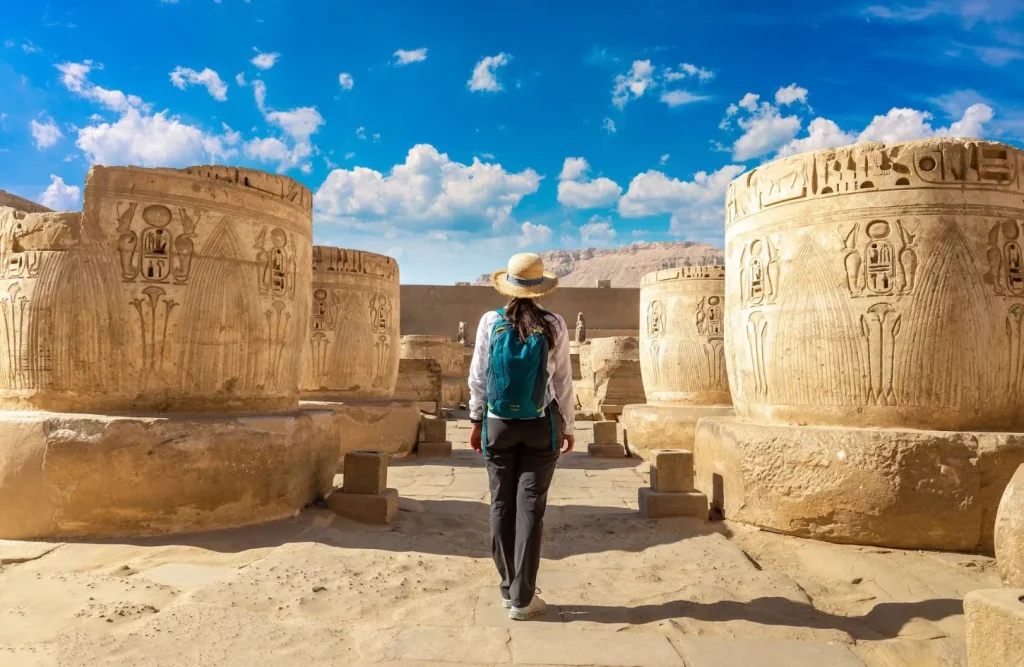
The Mortuary Temple of Ramses III at Medinet Habu on the West Bank of Luxor is one of the largest and best-preserved mortuary temples in Egypt, and one that visitors consistently find more rewarding than they expected. Built in the 12th century BCE, the temple is remarkable for the extraordinary quality and completeness of its painted relief decoration — walls covered in vivid scenes of Ramses III’s military campaigns against the Sea Peoples (a coalition of Mediterranean migrants whose incursions threatened Egypt in the late Bronze Age), religious ceremonies, and mythological narratives.
The temple complex includes an unusual fortified gateway — a structure modeled on the migdol towers of Syro-Palestinian fortresses, suggesting direct influence from Egypt’s Asian campaigns — and a series of royal apartments where Ramses III is believed to have actually resided for periods of time. The painted ceilings in several of the inner chambers retain their original colors with exceptional vividness. Medinet Habu receives far fewer visitors than the Valley of the Kings or Hatshepsut’s temple nearby, making it one of the most peaceful major sites on the West Bank.
10. Temple of Abydos
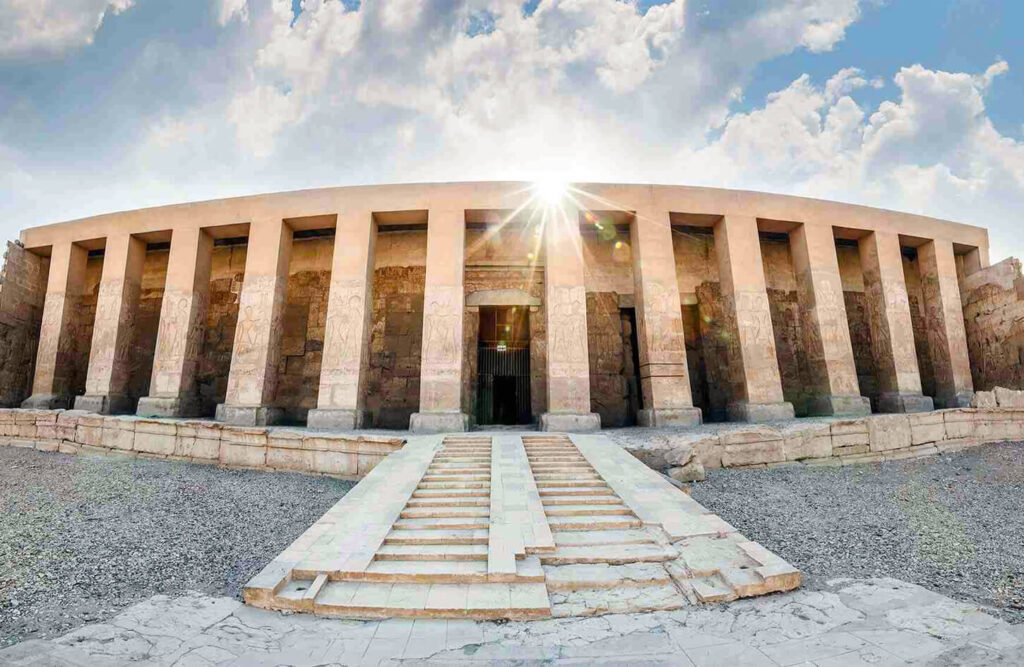
The Temple of Seti I at Abydos — located roughly 160 kilometres north of Luxor — contains what many Egyptologists consider the finest painted relief decoration in Egypt. Built in the early 13th century BCE and completed by Ramses II after Seti’s death, the temple was dedicated to the funerary cult of Osiris and to Seti himself, and its seven parallel sanctuaries each served a different deity of the Egyptian pantheon.
The painted reliefs throughout the temple are extraordinary in their preservation and artistry — colors that have survived three thousand years with a freshness and delicacy that consistently moves visitors who were not expecting to be moved. The temple also contains the famous Abydos King List: a carved sequence of 76 royal cartouches listing the pharaohs of Egypt from the earliest dynasties to Seti I, one of the most important historical documents from the ancient world. Nearby, the mysterious Osireion — a subterranean structure built to represent the mythological tomb of Osiris, partially submerged in groundwater — adds another layer of complexity to an already remarkable site.
Abydos is paired with Dendera in the Tour to Dendera and Abydos from Luxor, making a day trip that covers two of Upper Egypt’s most significant and underappreciated temple complexes.
Planning Your Top 10 Must-See Temples in Egypt Tour
The ten temples in this guide are spread across a stretch of the Nile valley roughly 700 kilometres long, from Abydos in the north to Abu Simbel in the far south. Seeing all of them in a single trip requires careful planning — but it is entirely achievable within a well-structured ten to fourteen day itinerary.
The most logical framework is a Classic Egypt tour that begins in Cairo (allowing time for the Grand Egyptian Museum and the Pyramids of Giza), flies to Luxor for the East and West Bank temples, travels south by Nile river cruise — stopping at Edfu and Kom Ombo — and finishes in Aswan with a day trip to Abu Simbel. Dendera and Abydos can be added as a day trip from Luxor before the cruise departs.
For travelers with less time, Egypt short breaks focused specifically on Luxor — covering Karnak, Luxor Temple, the Valley of the Kings, and Hatshepsut’s temple in three to four days — give an extraordinarily concentrated introduction to ancient Egyptian temple architecture. Adding a Luxor day tour to Dendera and Abydos extends this into one of the most rewarding short temple itineraries available anywhere in the world.
Whatever the length of your visit, the temples of Egypt will exceed your expectations. They were built to endure — and they have.