


Table of Contents
There is a part of Cairo that most visitors miss entirely — not because it is hard to find, but because it does not announce itself the way the Pyramids of Giza or the Grand Egyptian Museum do. Islamic Cairo is a living medieval city, a UNESCO World Heritage Site, and one of the most extraordinary concentrations of Islamic architecture anywhere in the world. Its streets have been continuously inhabited for over a thousand years. Its mosques were built by sultans whose names you will recognise from history books. Its markets have been trading since the 14th century.
For travelers on Cairo day tours or building longer Egypt trips, Islamic Cairo is not an optional addition to the standard itinerary — it is one of the city’s essential experiences. This guide covers the district’s history, its most important monuments, how to navigate it, where to eat, and how to plan your visit whether you are coming independently or as part of organized Cairo tours.
Why Islamic Cairo Is Unlike Anywhere Else
Islamic Cairo — known in Arabic as al-Qahira al-Islamiyya — covers the historic core of the city founded by the Fatimid dynasty in 969 CE. Unlike the medieval centers of many great cities, which survive as carefully preserved museum pieces, Islamic Cairo remains a living neighborhood: people are born here, work here, worship here, and have done so in an unbroken chain stretching back more than a millennium. Walking its streets, you encounter not just ancient monuments but a culture that has absorbed and adapted to a thousand years of change while remaining recognizably itself.
UNESCO estimates that the district contains over 600 listed monuments — mosques, madrasas, caravanserais, mausoleums, hammams, and historic houses — representing the full range of Islamic architectural traditions from the Fatimid and Ayyubid periods through the Mamluk golden age and into the Ottoman era. No other city outside the Arabian Peninsula has a comparable concentration of intact medieval Islamic heritage.
A Brief History of the District
The Fatimid caliph al-Mu’izz founded al-Qahira (“the victorious”) in 969 CE as a royal enclosure for his court and army, separate from the existing city of Fustat to the south. The great Al-Azhar Mosque — still one of the world’s foremost centers of Islamic scholarship — was completed just two years later, in 971 CE, and has been in continuous operation ever since.
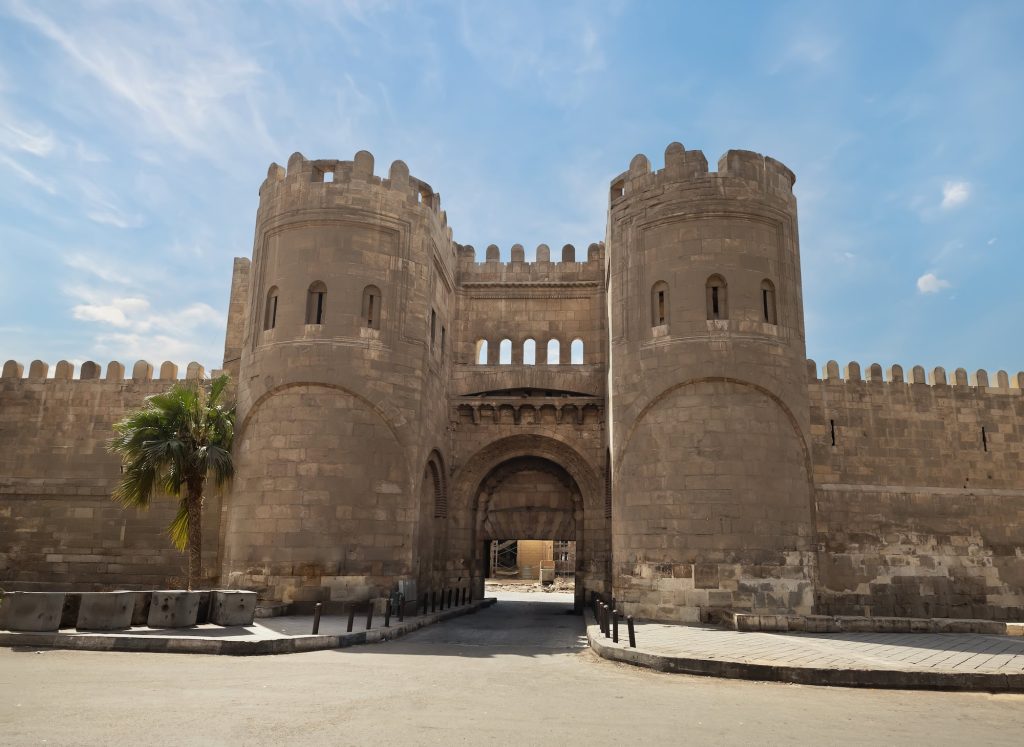
Under the Ayyubid dynasty (1171–1250 CE), founded by Saladin, the city expanded dramatically. Saladin built the Citadel of Cairo on the Mokattam spur overlooking the city — a fortress that would serve as Egypt’s seat of government for nearly 700 years — and enclosed the entire city within massive fortified walls, two of whose gates (Bab al-Futuh and Bab al-Nasr) still stand.
The Mamluk period (1250–1517 CE) produced Islamic Cairo’s most architecturally ambitious monuments. The Mamluks — a military caste of enslaved soldiers who seized power and ruled Egypt for nearly three centuries — were extraordinarily prolific builders, competing with each other and with history in the scale and elaboration of their mosques, madrasas, and mausoleums. The Sultan Hassan Mosque, the Qalawun Complex, and dozens of other Mamluk monuments along Al-Muizz Street represent the apex of medieval Islamic architecture in Egypt.
The Essential Monuments of Islamic Cairo
Al-Azhar Mosque
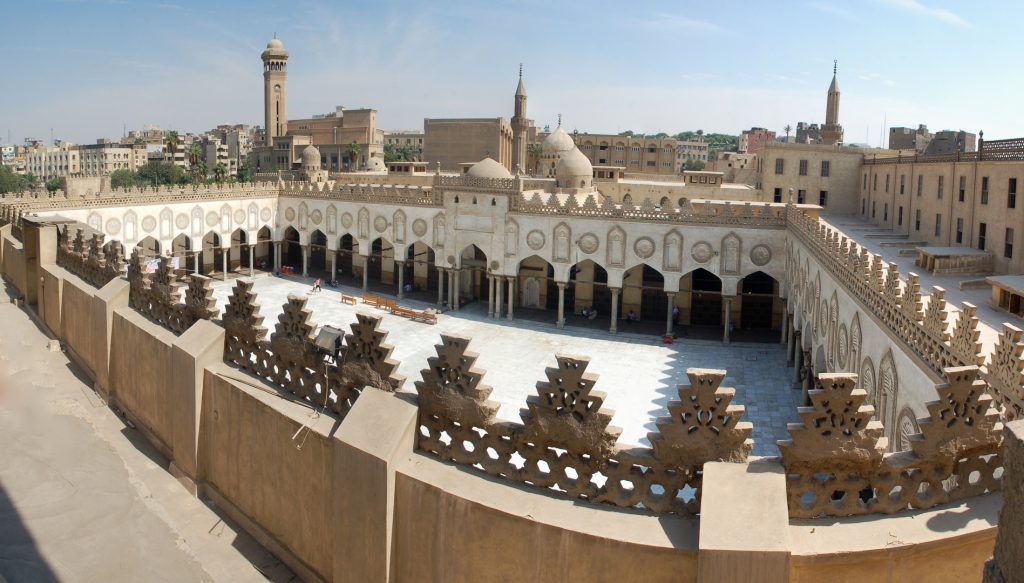
Founded in 970 CE, Al-Azhar Mosque is one of the oldest continuously functioning mosques in the world and the spiritual and intellectual heart of Islamic Cairo. Attached to it is Al-Azhar University — founded in 988 CE and widely considered the oldest university in the world — which has been teaching Islamic theology, law, and sciences for over a thousand years and continues to attract students from across the Muslim world. The mosque’s interior, with its forest of ancient columns and successive layers of architectural additions spanning ten centuries, is one of the most atmospheric spaces in Cairo. Non-Muslim visitors are welcome outside of prayer times.
The Sultan Hassan Mosque and Madrasa
Built between 1356 and 1363 CE, the Sultan Hassan Mosque is widely regarded as the masterpiece of Mamluk architecture — a building of such scale and ambition that it has influenced mosque design across the Islamic world for six centuries. Its facade, rising to nearly 38 metres, is one of the most imposing in Islamic architecture; its interior courtyard, with a central fountain and four massive iwans (vaulted halls) opening onto it, demonstrates the Mamluk ability to organise enormous spaces with complete architectural coherence. The mausoleum chamber contains the tomb of Sultan Hassan himself, though his body was never actually interred there — he was assassinated before the building was completed.
Ibn Tulun Mosque
The Ibn Tulun Mosque, built between 876 and 879 CE, is the oldest intact mosque in Cairo and one of the oldest in the world. Its design draws on Abbasid architectural traditions from Iraq — where its builder, Ahmad ibn Tulun, was raised — and is unlike any other mosque in Egypt: a vast open courtyard surrounded by covered arcades, with a distinctive spiral minaret that echoes the famous minaret of the Great Mosque of Samarra in Iraq. The mosque has a powerful, austere quality that contrasts with the decorative richness of later Mamluk buildings, and its size — it covers nearly 2.5 hectares — gives a sense of Cairo’s ambition even in its earliest Islamic period.
The Citadel of Cairo and the Muhammad Ali Mosque
The Citadel of Cairo, begun by Saladin in 1176 CE on a rocky spur of the Mokattam hills, served as Egypt’s seat of government from the 13th century until the 19th — a period spanning the Ayyubid, Mamluk, and Ottoman dynasties. Its ramparts and towers offer some of the best panoramic views of Cairo, with the minarets of Islamic Cairo spread out below and the Pyramids of Giza visible on clear days on the western horizon.
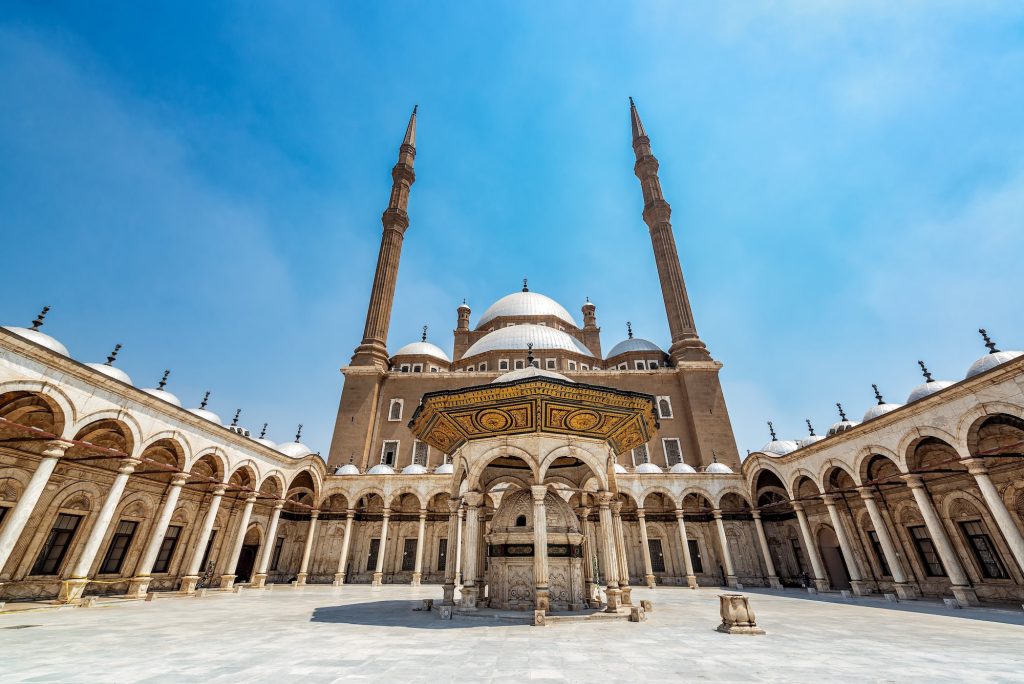
The dominant building within the Citadel is the Muhammad Ali Mosque, completed in 1848. Built in an Ottoman style inspired by the great mosques of Istanbul — particularly the Blue Mosque — it is one of the largest mosques in Egypt and its alabaster-clad exterior and twin minarets have made it one of Cairo’s most recognizable skyline features. The interior, with its enormous central dome and hanging brass chandeliers, is genuinely impressive despite its relatively recent date.
Al-Muizz Street
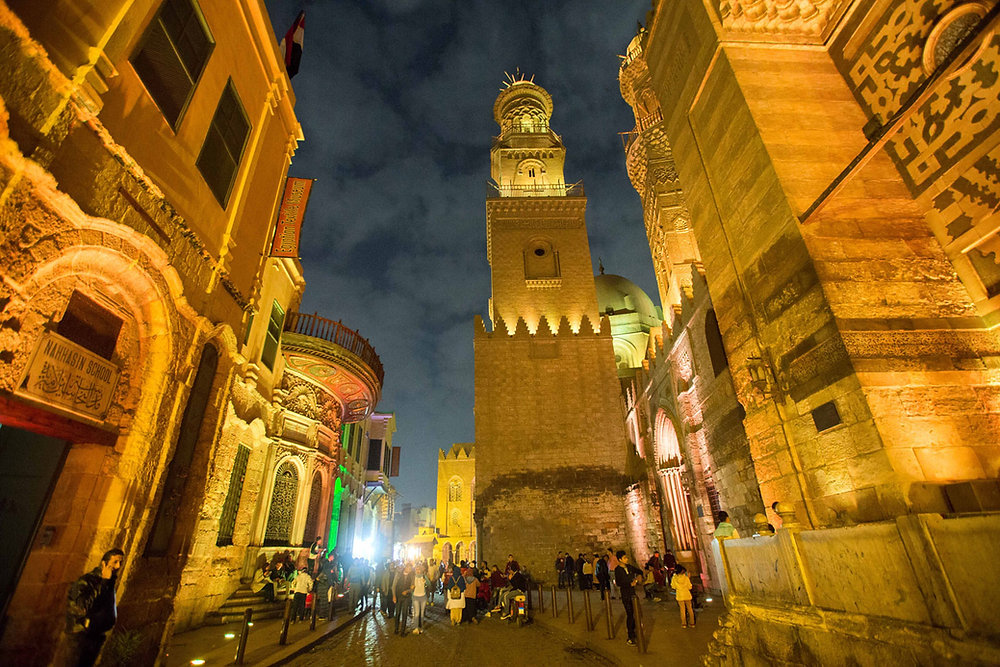
Al-Muizz Street — the historic spine of Islamic Cairo, running between the medieval gates of Bab al-Futuh in the north and Bab Zuwayla in the south — is the single most rewarding walk in Cairo for anyone interested in Islamic architecture. The street is essentially an open-air museum of a thousand years of mosque, madrasa, and commercial architecture, with monuments from virtually every dynasty that ruled Egypt crowded together along its length. The Qalawun Complex (13th century), the Al-Aqmar Mosque (12th century), the Barquq Complex (14th century), and dozens of others are all within walking distance of each other.
The street is partially pedestrianized and best walked in the morning or early evening, when the light is good and the heat is manageable. Allow at least two hours for the full length; more if you want to enter the individual monuments.
Khan el-Khalili
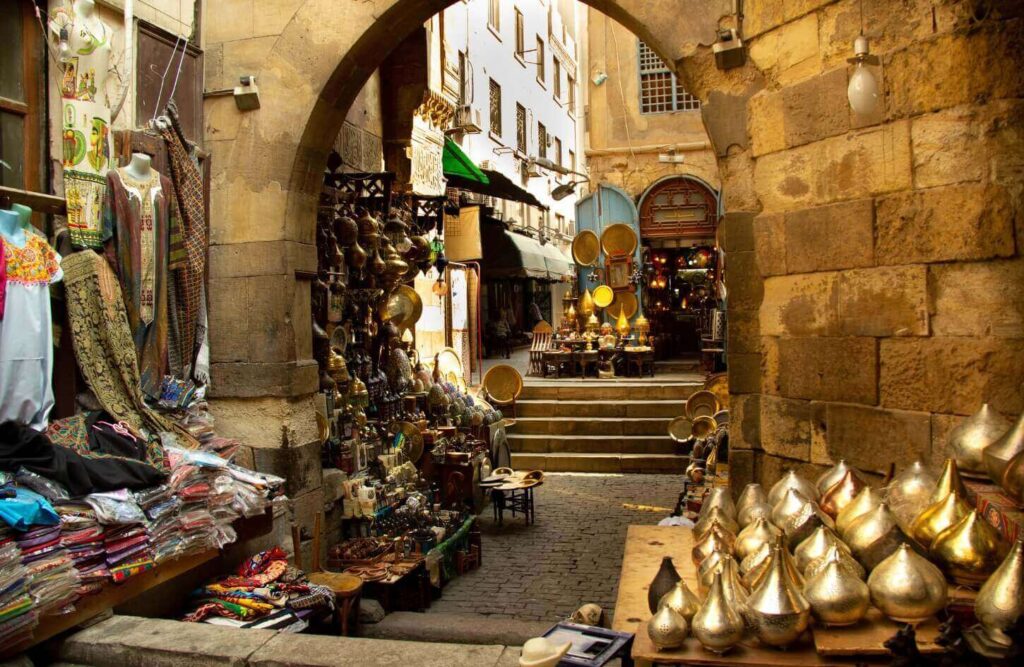
Khan el-Khalili is Cairo’s great medieval bazaar — a caravanserai complex founded in 1382 CE that has been in continuous commercial operation for over 600 years. The main tourist-facing alleyways sell gold jewelry, spices, papyrus, lanterns, textiles, and souvenirs of every description; go deeper into the surrounding streets and you find specialist workshops producing copper and brasswork, leather goods, and traditional clothing for a predominantly local clientele.
Haggling is expected and entirely normal — start at roughly half the asking price and work from there. The market is at its most atmospheric in the late afternoon and early evening, when the crowds thin slightly and the lanterns come on. The Al-Fishawi café, which has been open continuously for over 200 years in an alleyway off the main market, is worth stopping at for tea or coffee regardless of whether you are shopping.
Bab al-Futuh, Bab al-Nasr, and the Medieval Walls
The two northern gates of Islamic Cairo — Bab al-Futuh (“Gate of Conquests”) and Bab al-Nasr (“Gate of Victory”) — were built in 1087 CE and are among the finest surviving examples of medieval Islamic military architecture anywhere in the world. It is possible to climb up and walk along the top of the walls between the two gates, passing through the towers and looking down over the rooftops of the historic district. This is one of Cairo’s most overlooked experiences and one of the most rewarding.
Bayt al-Suhaymi
Bayt al-Suhaymi (“the House of al-Suhaymi”) is a magnificently restored 17th-century merchant’s house that gives the clearest available picture of domestic life in Ottoman Cairo. Built around a central courtyard with a fountain, the house contains elaborately decorated reception rooms, a harem quarter screened by wooden mashrabiyya lattices, and a garden that functions as a cool oasis in the middle of the historic district. It is one of the quietest and most beautiful spaces in Islamic Cairo and consistently undervisited relative to the great mosques.
Planning Islamic Cairo Into Your Cairo Itinerary
Islamic Cairo pairs most naturally with Coptic Cairo — the two districts together cover the pre-modern history of the city from the Roman period through a thousand years of Islamic civilization. The Private Day Tour to Coptic and Islamic Cairo structures this combination into a single well-organized day, with expert guidance that provides the historical context to make both areas considerably more rewarding. For first-time visitors to Cairo who want to go beyond the Pyramids and the GEM, this is one of the most comprehensive and satisfying day experiences the city offers.
As a standalone visit, Islamic Cairo can fill a full day comfortably — Al-Muizz Street, the Citadel, Khan el-Khalili, and one or two of the major mosques is already a substantial itinerary. If you are combining it with Coptic Cairo in the same day, start in Coptic Cairo in the morning and move north to Islamic Cairo in the afternoon, finishing in Khan el-Khalili as the evening light comes in. For travelers looking to extend the day into an evening, the Cairo Dinner Cruise and Oriental Show makes a natural complement — moving from the city’s ancient layers to the Nile as the sun goes down.
For travelers on Egypt travel packages that combine Cairo with Luxor and Aswan, Islamic Cairo fits naturally into the Cairo section as a half to full day that gives the city’s pharaonic heritage a different and equally important dimension. Understanding the Mamluk and Fatimid periods — their architecture, their scholarship, their relationship to the ancient monuments around them — enriches the experience of the rest of Egypt considerably. Travelers building Egypt holiday packages of a week or more will find that a full day in Islamic Cairo is one of the most rewarding investments of time they can make in Cairo.
Food and Drink in Islamic Cairo
The streets around Khan el-Khalili and Al-Azhar contain some of Cairo’s best street food. Koshari — the layered Egyptian dish of pasta, lentils, rice, and spiced tomato sauce — is available at several dedicated restaurants near the market at prices that make it one of the best-value meals in the city. Ta’ameya (Egyptian falafel from fava beans), hawawshi (spiced minced meat in crispy bread), and fresh-squeezed juice from street carts are all reliable options for a quick, cheap, and genuinely good meal between monument visits.
For a sit-down experience, the restaurants around Al-Hussein Square serve traditional Egyptian food in settings that have been feeding visitors for generations. The area is particularly lively on Thursday and Friday evenings, when Cairenes come to the square in large numbers and the atmosphere approaches something close to a street festival.
Best Time to Visit Islamic Cairo
The most comfortable window is October through April, when Cairo’s temperatures are manageable for the considerable walking that exploring Islamic Cairo involves. The district’s narrow streets provide some shade, but summer temperatures (regularly exceeding 38°C between June and August) make a full day of monument-visiting genuinely demanding.
Within the day, early morning visits to the major mosques — arriving before the large tour groups — give you the quietest and most atmospheric experience. Late afternoon into evening is the best time for Khan el-Khalili and the street life of the district. Friday mornings are the busiest at the mosques (Friday prayers draw large congregations) but also the most spiritually alive — visiting immediately after prayers, when the worshippers are still present, gives a sense of these buildings as living places of faith rather than museum pieces.
How to Get to Islamic Cairo
The most convenient metro option is Al-Azhar Station (Line 2) or Ataba Station (Lines 1 and 2), both within easy walking distance of Khan el-Khalili and Al-Muizz Street. Uber and Careem serve the area reliably, though traffic in and around the historic district can be heavy during peak hours. For the Citadel, a separate taxi or Uber journey from the main Islamic Cairo sites is the most straightforward approach — it sits on a hill above the district and is not easily combined with Al-Muizz Street on foot.
Practical Tips for Visiting Islamic Cairo
- Dress modestly — shoulders and knees covered for both men and women. Women should carry a light scarf for entering mosques; some require hair covering inside. Shoes must be removed at the entrance to most mosques.
- Visit mosques outside of prayer times where possible — the five daily prayer times (particularly midday and Friday prayers) temporarily close mosques to non-worshippers. Check times in advance or ask locally.
- Al-Muizz Street is partially pedestrianized — wear comfortable shoes and allow more time than the distance suggests, as the monuments reward slow looking rather than quick passing.
- The Citadel and the main Islamic Cairo sites are not within easy walking distance of each other — plan a taxi between them rather than attempting to walk, particularly in summer.
- In Khan el-Khalili, the first price quoted is almost always negotiable. A polite, unhurried approach to bargaining is more effective than aggressive counter-offers.
- Carry small denomination Egyptian pounds for entrance fees, tips, and street food purchases. Most smaller shops and stalls do not accept cards.
- The rooftop of the Bab al-Futuh gate and the walk along the medieval walls to Bab al-Nasr are free to access and offer views of the historic district that most visitors never see — worth the slight detour at the northern end of Al-Muizz Street.
Is Islamic Cairo Worth the Time?
Without question — and it is one of the more consequential decisions a traveler to Cairo can make. The Pyramids of Giza represent ancient Egypt’s pharaonic achievement at its most monumental. Islamic Cairo represents something equally extraordinary: a thousand years of continuous urban civilization, preserved in stone and brick and timber, still inhabited and still functioning as it has been since the Fatimids founded the city in 969 CE.
The Sultan Hassan Mosque, the Ibn Tulun Mosque, Al-Muizz Street, and Khan el-Khalili together constitute one of the great historic urban environments in the world — comparable in significance and atmosphere to the medinas of Fez or Marrakech, the old city of Jerusalem, or the historic center of Istanbul, but far less visited than any of them. For travelers on Cairo tours who want to understand what Cairo actually is — not just its ancient past but its medieval and living present — Islamic Cairo is where that understanding begins.

