


Table of Contents
Finding the perfect Egypt souvenirs is one of those travel experiences that sneaks up on you. You walk into Khan el-Khalili intending to spend twenty minutes and emerge two hours later with a bag of spices, a piece of papyrus art, and a strong opinion about the correct price for a silver cartouche. The markets and bazaars of Egypt — from Cairo’s medieval alleyways to the quieter souqs of Luxor and Aswan — are as much a part of the travel experience as the temples and tombs, and they reward time spent browsing, negotiating, and asking questions about what you are looking at.
This guide covers the best souvenirs to buy in Egypt, where to find authentic pieces, how to avoid common pitfalls, and how the country’s great shopping destinations fit into broader Egypt trips and Egypt holidays. Whether you are on a short Cairo day tour, cruising the Nile between Luxor and Aswan, or building a longer Egypt holiday package around the country’s cultural sites, Egypt’s markets offer something genuinely worth bringing home.
Why Egypt Souvenirs Are Worth the Effort
Egypt’s craft traditions are among the oldest in the world, and many of them remain genuinely alive — not as tourist-facing performances, but as working practices passed through generations of artisans. The alabaster workshops near Luxor still use techniques developed in antiquity. The Nubian weavers of Aswan produce textiles in patterns that predate the Arab conquest of Egypt by a thousand years. The perfumers of Cairo’s old city blend essential oils using methods recorded in ancient Egyptian medical papyri.
This depth of tradition means that shopping thoughtfully in Egypt — taking the time to find genuine handmade pieces rather than mass-produced imports — puts you in contact with something real. The souvenirs you carry home are not just decorative objects; they are connections to a living craft culture that has survived extraordinary historical pressures.
Papyrus Art: Ancient Tradition, Modern Market
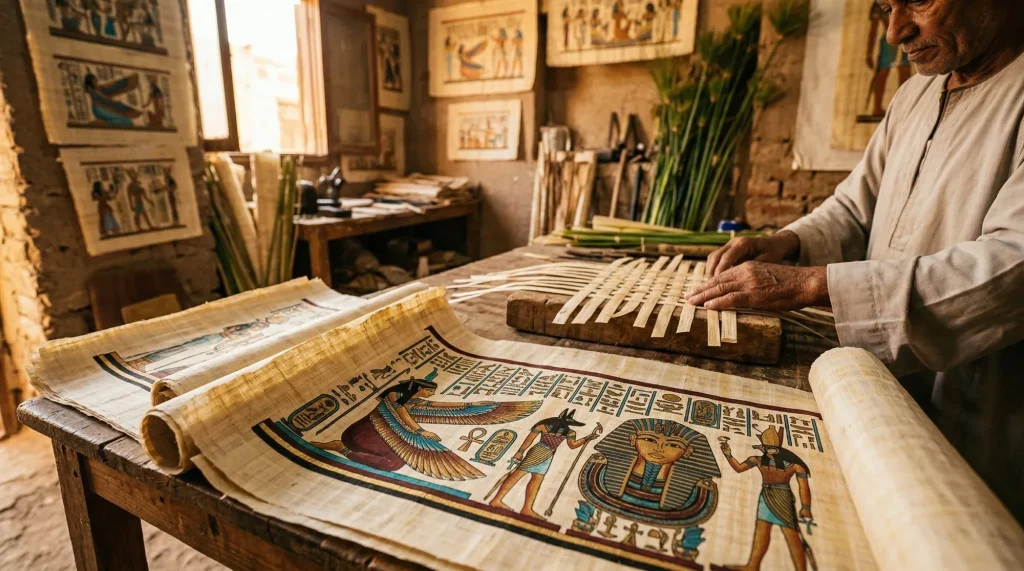
Papyrus art is one of Egypt’s most iconic souvenirs — and also one of the most frequently faked. Genuine papyrus is made from the papyrus plant (Cyperus papyrus), still cultivated in Egypt, by slicing the stems into thin strips, pressing them together in perpendicular layers, and drying the resulting sheet under pressure. The finished material has a distinctive texture: slightly rough, with visible plant fibres running through it, and a natural cream-to-brown colour that varies with the plant’s age.
Most of what is sold in tourist-facing markets is banana leaf paper or printed plastic sheeting, neither of which has any connection to the ancient tradition. The simplest test is to try to roll the sheet: genuine papyrus flexes and springs back without cracking; banana paper tears or creases. Reputable papyrus galleries — there are several good ones in Cairo and Luxor — will demonstrate the production process and provide certificates of authenticity. The price difference is real but justifiable for a piece that will last for centuries.
When choosing a design, look for artwork that shows genuine skill: finely detailed hieroglyphic scenes, accurate representations of gods and pharaohs, and careful use of the natural earth pigments traditional to the craft. Avoid mass-produced prints with photographic regularity — the irregularities of handmade art are a feature, not a flaw.
Handcrafted Egyptian Jewelry: Symbols with Meaning
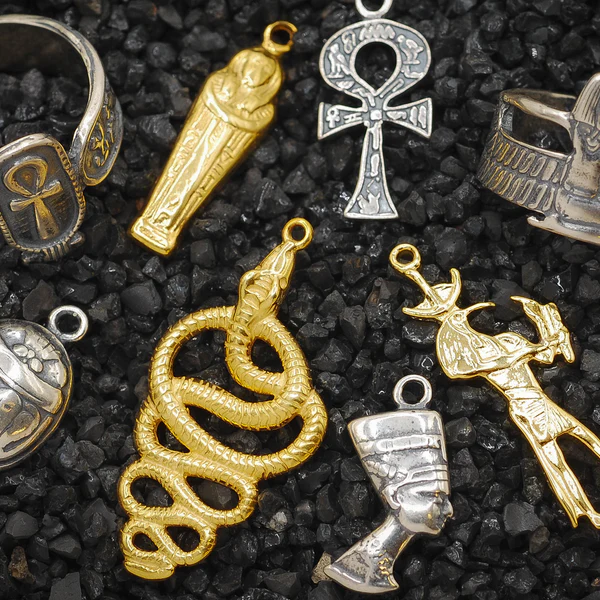
Egyptian jewelry has been among the most sophisticated in the world since at least the Old Kingdom period, and the best contemporary pieces continue that tradition. The symbols that recur throughout ancient Egyptian art — the ankh (symbol of life), the scarab beetle (regeneration and protection), the Eye of Horus (healing and protection), the cartouche (a royal name frame that can be personalised) — appear in jewelry made in gold, silver, and semi-precious stones throughout Egypt’s markets.
The quality range is enormous. At the lower end, mass-produced pieces made from base metals with thin plating are common in tourist-facing stalls; these are fine as inexpensive keepsakes but will not last. At the higher end, skilled goldsmiths and silversmiths in Cairo’s Khan el-Khalili and the jewelry districts of Islamic Cairo produce handmade pieces of genuine quality, often working to commission. If you want a cartouche with your name in hieroglyphics — one of the most popular personalised souvenirs in Egypt — allow time for it to be made properly rather than buying a pre-made piece.
When buying jewelry, ask about the metal content and request a receipt that specifies it. Genuine gold and silver pieces will be hallmarked; Egyptian law requires this for locally sold precious metals. A reputable seller will explain the hallmarking system without hesitation.
Egyptian Cotton: A Luxury Worth the Luggage Weight
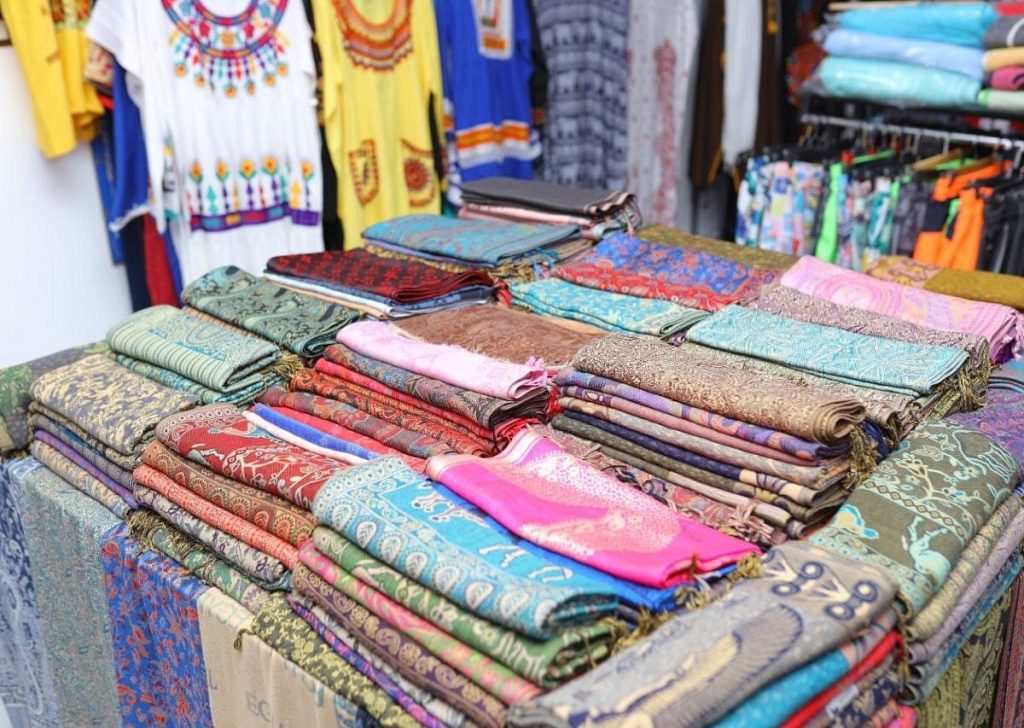
Egyptian cotton has a global reputation for softness and durability that is entirely deserved. The long-staple varieties grown in the Nile Delta produce fibres that are finer, stronger, and more absorbent than short-staple cotton, resulting in fabrics with a smoothness and weight that is immediately apparent to the touch. Bed linens, towels, and clothing made from genuine Egyptian cotton are among the most practical and long-lasting souvenirs you can bring home.
The key word, as with papyrus, is genuine. Much of what is sold as Egyptian cotton in tourist markets is blended with cheaper fibres or made from lower-grade Egyptian cotton that does not merit the premium reputation. Look for products labelled 100% Egyptian cotton with a thread count of at least 300 for bed linens. Reputable department stores and established textile shops in Cairo and Alexandria are more reliable sources than market stalls for high-quality cotton goods.
Galabiyyas — the long, loose Egyptian robes worn by both men and women — are also worth considering. Well-made cotton galabiyyas are comfortable, practical garments that work as loungewear or light summer clothing, and they are available in a wide range of qualities and fabrics from the markets of Khan el-Khalili and Luxor.
Spices and Edible Souvenirs from Egyptian Bazaars
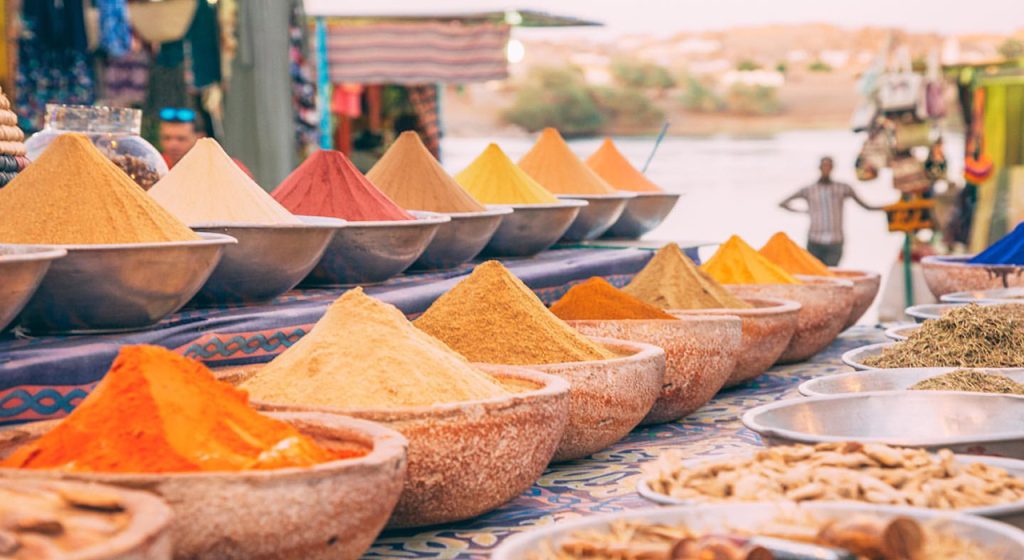
Egypt’s spice markets are among the most sensory experiences the country offers — walls of open sacks containing cumin, coriander, cardamom, dried hibiscus (karkadeh), fenugreek, black seed (nigella), and dozens of other spices and dried herbs, priced by weight and sold loose. Buying spices in Egyptian markets gives you access to freshness and variety that supermarket packaging rarely matches, and at prices that make experimenting with unfamiliar ingredients very easy.
Dukkah — a coarsely ground blend of nuts, seeds, and spices typically including hazelnuts, sesame, cumin, and coriander — is one of the most versatile Egyptian edible souvenirs: excellent as a dip with bread and olive oil, as a crust for meat or fish, or simply sprinkled over salads. Ras el hanout, a complex North African spice blend, is another worthwhile purchase. Dried hibiscus flowers, used to make the deep red, slightly tart tea called karkadeh, travel well and produce a drink that is genuinely distinctive and associated with Egypt in a way that few other flavours are.
Pack spices in sealed bags inside your main luggage rather than carry-on, and declare them at customs if required by your destination country — most dried spices are permitted internationally, but regulations vary.
Alabaster and Pharaonic Replicas
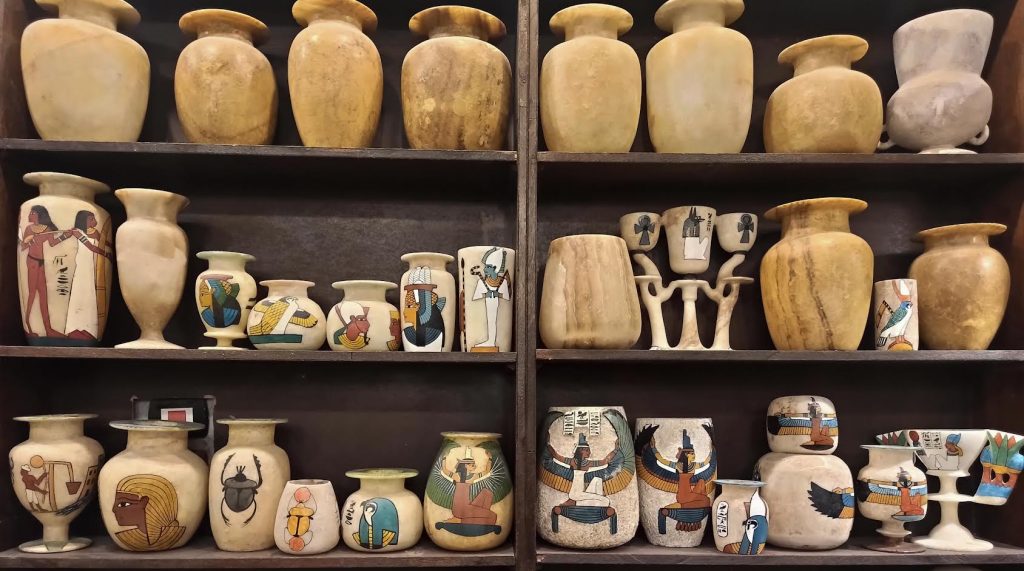
Alabaster — the smooth, translucent stone quarried near Luxor since antiquity — is worked into bowls, vases, canopic jars, scarabs, and decorative objects in workshops that have operated in essentially the same location for thousands of years. The stone’s natural translucency means that a well-made alabaster piece held up to light glows from within — an effect that makes even relatively simple objects visually striking. Quality varies significantly: look for even colour, smooth finishing without visible tool marks, and translucency that is consistent rather than patchy.
Pharaonic replicas — statues, busts, and decorative objects based on ancient Egyptian originals — range from mass-produced resin pieces of no particular merit to carefully handmade reproductions in traditional materials. The best replicas are made from alabaster, wood, or stone and show genuine attention to the detail and proportion of the originals. Museum shops — particularly at the Grand Egyptian Museum near the Pyramids and the Luxor Museum — carry licensed reproductions of high quality that are worth the premium over market prices for anyone who wants a piece with documented authenticity.
Nubian Crafts: Aswan’s Most Distinctive Souvenirs
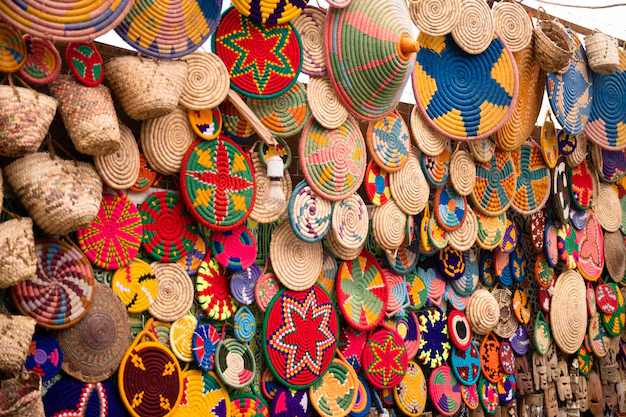
The Nubian culture of southern Egypt has its own craft traditions quite distinct from those of the rest of the country — and the markets of Aswan, particularly the Aswan Souk and the villages of the west bank, are the best place to find them. Nubian textiles in bold geometric patterns, hand-woven baskets, carved wooden items, and colourful pottery decorated with traditional Nubian motifs are all available, and the relative lack of mass tourism compared to Cairo and Luxor means that quality and authenticity are generally higher.
Visiting a Nubian village directly — rather than buying Nubian-branded goods in a Cairo market — is both a better way to find genuine pieces and a more meaningful experience. The Trip to the Nubian Villages by Boat from Aswan takes you across the Nile to communities where crafts are still made and sold by the people who produce them, with the context and hospitality that a market stall cannot provide. For travelers on Aswan day tours that include time on the west bank, this is one of the most rewarding ways to combine shopping with genuine cultural encounter.
Perfume Oils and Essence: Egypt’s Liquid Heritage
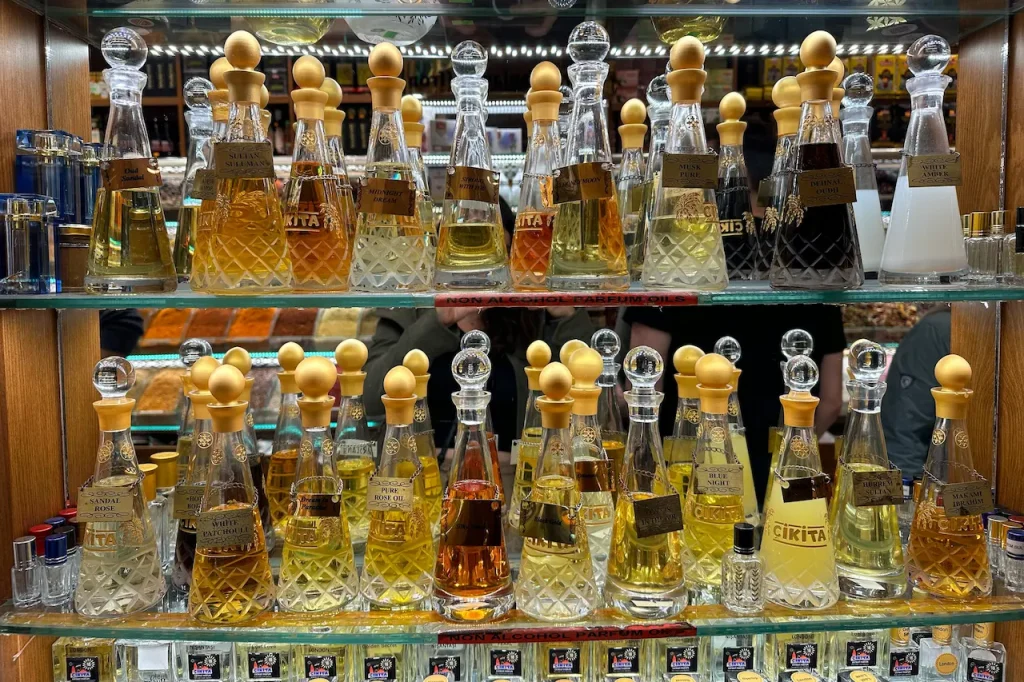
Egypt has a long tradition of perfumery — ancient Egyptian temples were filled with incense, and perfume oils feature prominently in both religious texts and medical papyri. Contemporary Egyptian perfumers, particularly in Cairo’s Khan el-Khalili and the surrounding streets of Islamic Cairo, produce essential oils and perfume blends in an extraordinary range of fragrances, sold in small ornate bottles that are themselves collectable.
The experience of visiting a good Cairo perfumery — being guided through fragrance families, trying combinations on your skin, and discussing the origins and uses of individual ingredients — is one of the more pleasurable shopping experiences Egypt offers. The oils are concentrated and long-lasting; a small bottle travels easily and lasts for months. As with all Egyptian souvenirs, quality varies: a reputable perfumery will let you smell individual ingredients and explain the blending process rather than just presenting you with pre-packaged bottles.
Where to Shop: The Best Markets in Egypt
Khan el-Khalili, Cairo
Khan el-Khalili in Cairo is the oldest and most famous bazaar in Egypt — a 14th-century market complex that has been in continuous operation for over 600 years. Its maze of narrow alleyways contains hundreds of shops selling everything from gold jewelry and spices to lanterns, textiles, and tourist trinkets. The experience of navigating it — particularly in the early evening when the crowds thin and the lanterns come on — is memorable regardless of whether you buy anything. For the best shopping, go beyond the main tourist-facing alleyways into the surrounding streets of Islamic Cairo, where specialist merchants sell to a predominantly local clientele and prices reflect it.
A Private Day Tour to Coptic and Islamic Cairo passes through this area as part of a broader exploration of Cairo’s historic districts — a natural way to combine shopping with context, since understanding the history of the neighborhood makes the market experience considerably richer.
Luxor Spice Market and Souq
The markets of Luxor — on both the East Bank near Luxor Temple and in the West Bank villages — are smaller and more manageable than Khan el-Khalili, with a strong focus on spices, alabaster, and Pharaonic replicas produced in the workshops visible throughout the area. Prices are negotiable and the atmosphere is generally more relaxed than Cairo. Travelers on Luxor day tours that include time in the town itself will find the souq worth an hour of browsing, particularly for spices and locally made alabaster pieces.
Aswan Souk
The Aswan Souk along the Corniche is one of the most pleasant markets in Egypt — less pressured than Cairo, with a strong selection of Nubian crafts, spices, and textiles alongside the usual range of Egyptian souvenirs. The presence of traders from Sudan and sub-Saharan Africa gives the market a variety not found further north, including musical instruments, carved wooden items, and textiles in styles distinctly different from mainstream Egyptian craft. For travelers on Aswan day tours, a morning in the souk before or after a Nile temple visit is an easy and rewarding combination.
Shopping Along the Nile: Cruise Markets and Riverside Stops
Travelers on an Egypt Nile cruise between Luxor and Aswan have the opportunity to shop at several of the riverside towns the cruise stops at — Edfu, Kom Ombo, and Esna — each of which has a small market near the temple. These markets are generally less well-stocked than the main city souqs but offer the convenience of browsing immediately after a temple visit, and prices are sometimes lower than in the major tourist centers.
A Nile cruise also allows for a more relaxed approach to shopping overall: rather than feeling the pressure to buy everything in a single market visit, you encounter different options at each stop and can compare before committing. For travelers building an Egypt holiday package that includes a river cruise, this distributed shopping experience is one of the underappreciated pleasures of traveling by boat.
Tips for Shopping in Egyptian Markets
- Haggling is expected in most Egyptian markets — it is a social convention as much as a commercial one. A reasonable opening position is roughly half to two-thirds of the asking price; the final price usually lands somewhere in between. Fixed-price shops exist and will say so; respect that and do not negotiate there.
- Cash is essential in markets and smaller shops. Egyptian pounds are preferred; US dollars are widely accepted but at less favorable rates. Have small denominations available.
- Authenticity certificates matter for papyrus, jewelry, and antiques. Request them from reputable sellers and keep them with your receipts for customs purposes.
- Antiques and genuine antiquities (items over 100 years old) cannot legally be exported from Egypt without government documentation. Items sold as “genuine antiques” in tourist markets are almost always reproductions — which is itself useful to know when assessing price.
- Morning visits to markets are generally more productive than afternoons: vendors are fresher, the light is better, and the largest tour groups have not yet arrived.
- Pack carefully for fragile items — papyrus art, alabaster pieces, and glass perfume bottles all need individual wrapping and protection within your luggage. Carrying them in a separate padded bag within your main case is more reliable than checking fragile items in regular luggage.
Planning Shopping Into Your Egypt Itinerary
The best shopping in Egypt is not a separate activity from the rest of your trip — it is woven into it. Khan el-Khalili is most rewarding when you have already spent time in Islamic Cairo and understand the context of the neighborhood around it. The alabaster workshops of Luxor make more sense after you have seen the ancient quarries nearby. The Nubian craft markets of Aswan are a natural extension of visiting the Nubian villages across the river.
For travelers on Egypt trips of a week or more, building half a day of unstructured market time into each major city gives enough space to shop thoughtfully rather than rushing. For those on shorter Egypt holidays or Cairo day tours, focusing on one market done well — Khan el-Khalili in Cairo, the Aswan Souk, the Luxor markets — is more satisfying than attempting to cover all of them superficially.
Whatever your itinerary — whether it is an Egypt holiday package covering Cairo, Luxor, and Aswan, a focused Nile cruise, or a series of Cairo day tours — Egypt’s markets will find a way to make themselves part of the story. They always do.

