


Table of Contents
Most visitors to Cairo spend their time at the Pyramids of Giza, the Grand Egyptian Museum, and the medieval alleyways of Islamic Cairo — and all of those are worth every minute. But tucked into the southern edge of the city, built on the foundations of a Roman fortress and containing some of the oldest Christian buildings in the world, is a quarter that many Egypt trips overlook entirely: Coptic Cairo.
The district is sometimes called Old Cairo or Mari Girgis (after the metro station that serves it), and it represents a layer of Egyptian history that predates Islam by several centuries. Its narrow streets, ancient churches, and extraordinary museum tell the story of Egypt’s Coptic Christian community — one of the oldest continuous Christian traditions in the world — and offer a perspective on Cairo’s history that no other part of the city can provide. This guide covers everything you need to plan your visit, whether you are coming as part of a dedicated Cairo day tour or building Coptic Cairo into a broader Egypt itinerary.
Why Coptic Cairo Matters
Coptic Cairo is built on the site of the ancient Roman fortress of Babylon, constructed around 30 BCE at a strategic point where the Nile branched into the Delta. The fortress became a significant settlement during the Roman and Byzantine periods, and it was here — according to tradition — that the Holy Family sheltered during their flight into Egypt, a journey described in the Gospel of Matthew. Several of Coptic Cairo’s oldest churches mark sites associated with that journey, giving the district a significance for Christian pilgrims that extends well beyond Egypt.
Christianity arrived in Egypt remarkably early. The Coptic Orthodox Church traces its founding to Saint Mark the Evangelist, who is believed to have preached in Alexandria around 42 CE — making it one of the oldest Christian communities in the world, predating the conversion of Rome by nearly three centuries. The churches, monasteries, and artifacts of Coptic Cairo are the living physical record of that tradition, preserved through the Arab conquest, the Crusades, the Ottoman period, and into the present day.
The Historical Layers of the District
Walking through Coptic Cairo, you are moving through multiple historical periods simultaneously. The foundations of the Roman fortress of Babylon are still visible at the entrance to the district — two round towers flanking the original water gate, now partially submerged as the ground level has risen over two millennia. The towers themselves have been absorbed into the surrounding urban fabric, with churches and monasteries built directly against and on top of them.
Above the Roman foundations rise Byzantine-era churches, some of which were already ancient when the Arab armies arrived in 641 CE. The Arab conquest did not erase the Coptic community — the Copts (from the Greek word for Egyptian) continued to practice their faith, develop their art, and maintain their institutions under successive Islamic dynasties, producing a culture that is distinctly and simultaneously Egyptian, African, and Christian. The result is a district where the 1st century and the 21st sit in direct conversation.
Must-See Sites in Coptic Cairo
The Hanging Church (Al-Mu’allaqa)
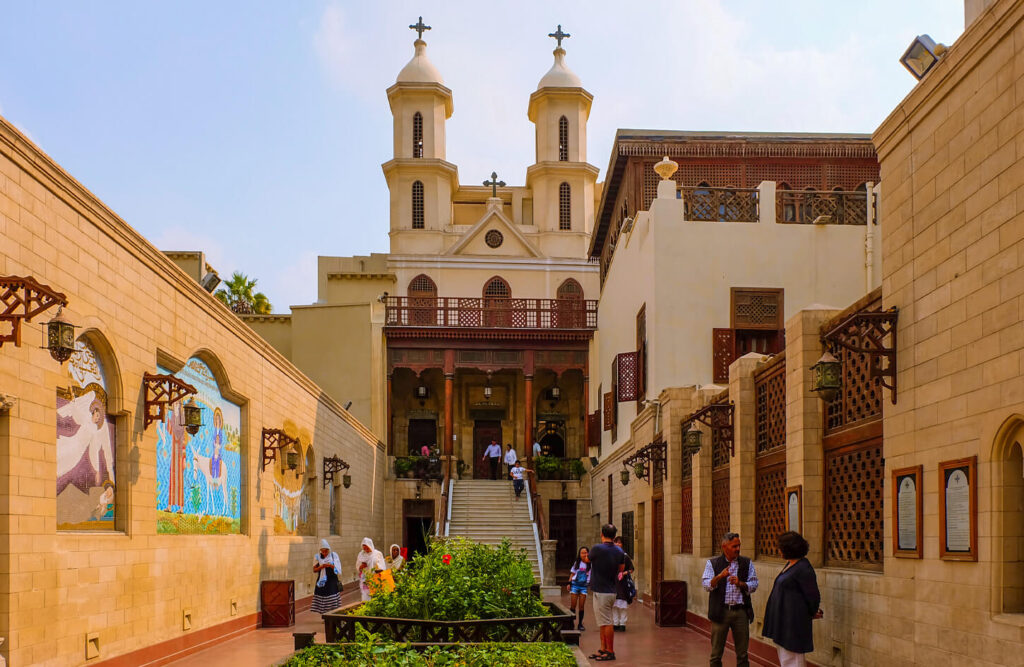
The Hanging Church — formally known as the Saint Virgin Mary’s Coptic Orthodox Church — is the most famous church in Coptic Cairo and one of the oldest in Egypt, with a history stretching back to at least the 4th century CE. Its name comes from its unusual position: the nave is suspended over the southern gatehouse of the Roman fortress of Babylon, with the floor of the church resting on the ancient walls below.
Entering through a narrow passageway and ascending a flight of stairs, you emerge into a space of unexpected beauty — a wooden nave decorated with ivory inlaid screens, 13th-century icons, and an extraordinary iconostasis of ebony and ivory that is one of the finest examples of medieval Coptic woodwork in existence.
The church is still an active place of worship and remains one of the most important in the Coptic Orthodox tradition. Visiting with appropriate respect for its living religious function makes the experience considerably richer.
The Church of Saints Sergius and Bacchus (Abu Serga)
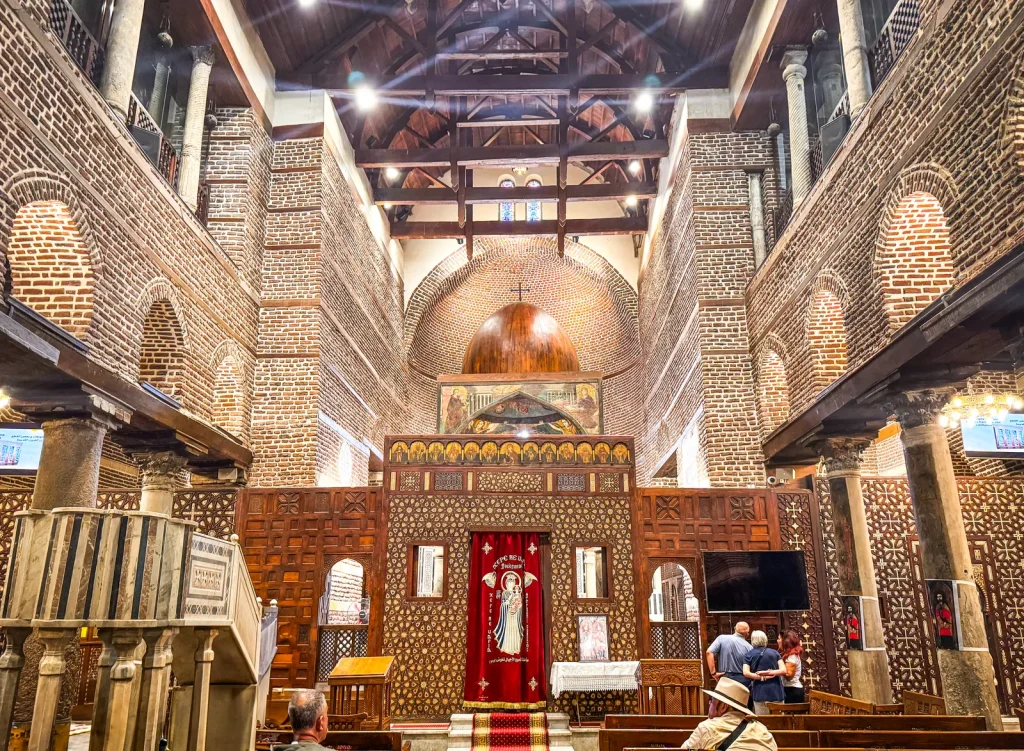
The Church of Saints Sergius and Bacchus, known locally as Abu Serga, is one of the oldest churches in Egypt — portions of it date to the 4th or 5th century CE, and it may incorporate even earlier structures. Its particular significance comes from its crypt: a cave beneath the church that tradition identifies as the place where the Holy Family rested during their time in Egypt. Whether or not the identification is historically verifiable, the crypt has been a site of Christian pilgrimage for at least 1,500 years, and the sense of accumulated devotion in the small underground space is palpable.
The church above the crypt is a beautiful example of early Coptic basilica architecture, with carved wooden screens, ancient columns recycled from earlier buildings, and icons spanning many centuries of Coptic artistic tradition.
The Church of Saint Barbara
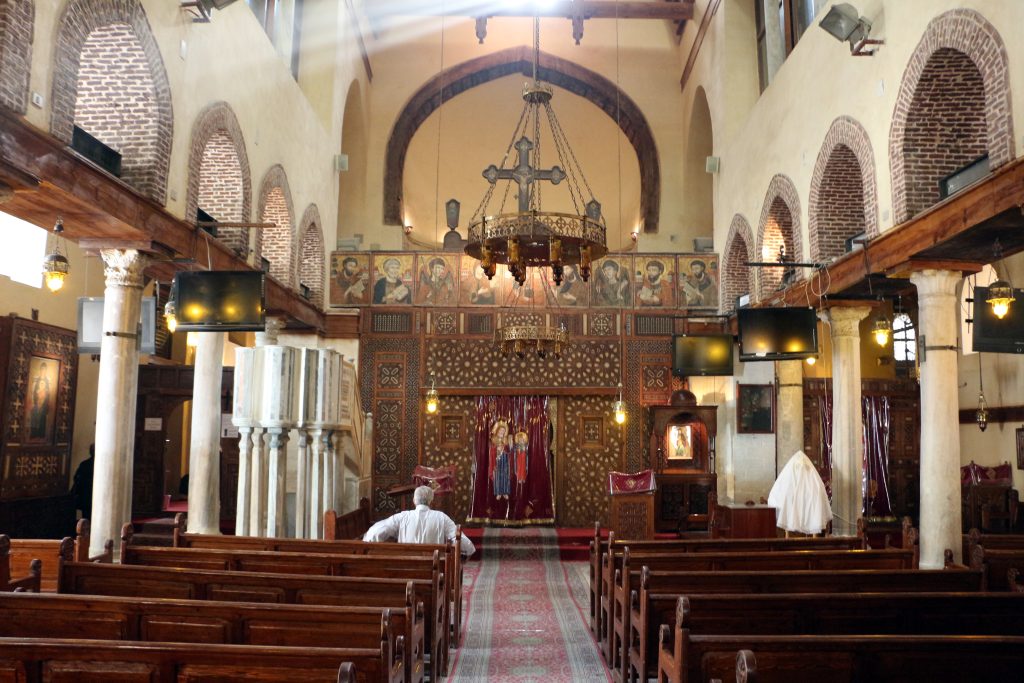
Built in the late 4th or early 5th century and rebuilt several times since, the Church of Saint Barbara is one of the largest churches in Coptic Cairo and contains some of the district’s finest examples of medieval Coptic woodwork. The church houses relics of Saint Barbara and Saint Catherine of Alexandria, and its interior — particularly the carved wooden sanctuary screen — demonstrates the extraordinary craftsmanship of medieval Coptic artisans working in a tradition that had already been continuous for several centuries.
The Ben Ezra Synagogue
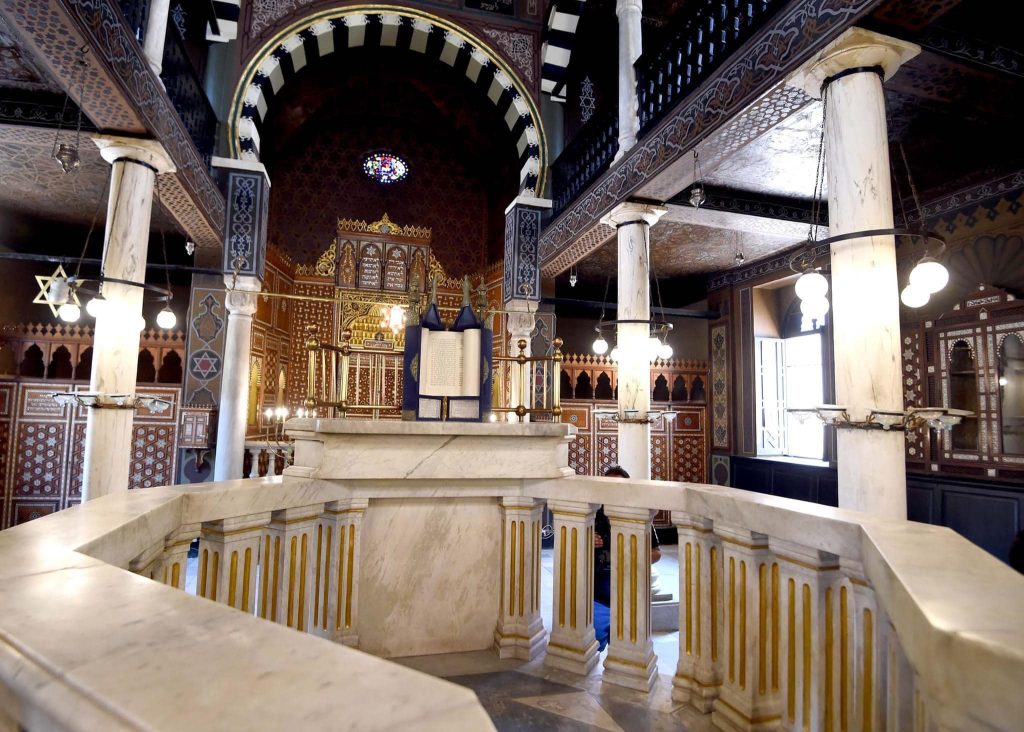
Slightly outside the core of the Coptic Christian sites but within easy walking distance, the Ben Ezra Synagogue is one of the oldest synagogues in Egypt, built on a site that Jewish tradition associates with the place where the infant Moses was found in the Nile. It was here, in the late 19th century, that the Cairo Geniza was discovered — a collection of over 300,000 Jewish manuscript fragments dating from the 9th to the 19th centuries that transformed the modern understanding of medieval Jewish life and commerce. The restored synagogue is open to visitors and offers another dimension of Coptic Cairo’s extraordinary religious diversity.
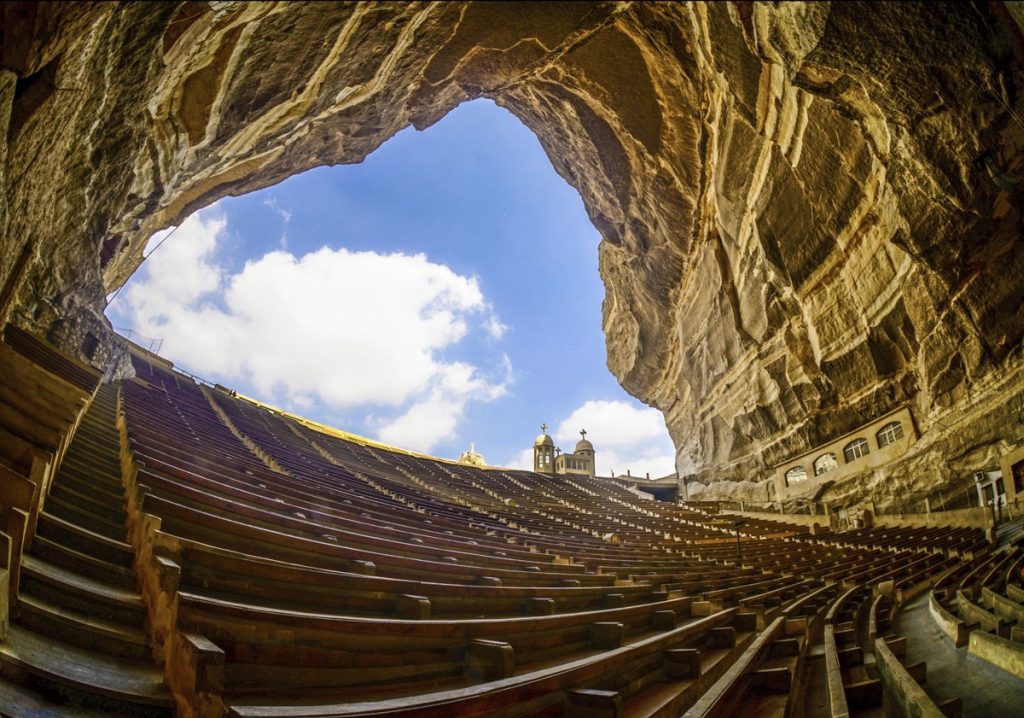
The Cave Church (Saint Simon the Tanner Monastery, Mokattam)
Strictly speaking, the Cave Church — formally the Monastery of Saint Simon the Tanner — is not part of Coptic Cairo itself. It sits in the Mokattam hills on the eastern edge of Cairo, carved into the cliff face above the city’s historic Zabbaleen (rubbish collectors’) quarter. But it belongs in any serious discussion of Cairo’s Christian heritage, and many travelers combine it with a Coptic Cairo visit in the same day.
The monastery complex contains several cave churches cut directly into the rock, the largest of which seats an estimated 20,000 worshippers — making it one of the largest churches in the Middle East. The main amphitheatre-style cave is decorated with enormous relief carvings of biblical scenes cut into the cliff face, a project that took decades and covers the entire back wall of the space. The effect is genuinely extraordinary: a vast natural rock cathedral, carved by hand, embedded in a cliff above a city of 20 million people.
The surrounding community has its own remarkable story — the Zabbaleen collect and recycle the majority of Cairo’s waste with an efficiency that has attracted global attention, and the monastery sits at the heart of a neighbourhood that has transformed itself through faith, industry, and community organisation. Visiting both the cave churches and the community around them gives a picture of living Coptic Christianity that the historic district alone cannot provide. Getting there requires a taxi or Uber to the Mokattam area — allow around 30 minutes from central Cairo.
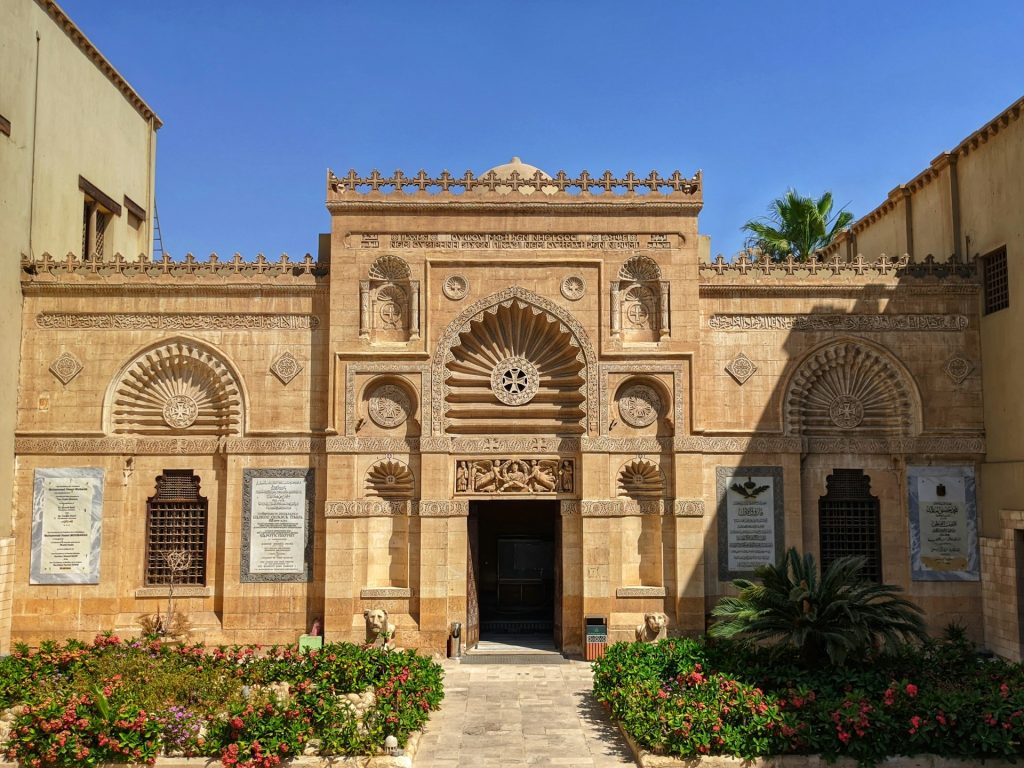
The Coptic Museum
The Coptic Museum holds the finest collection of Coptic Christian art in the world — over 16,000 objects spanning textiles, manuscripts, metalwork, woodwork, stonework, and icons, covering the period from the 3rd to the 19th century. The museum occupies two wings built around a garden, with the older wing containing some of the most architecturally distinctive interiors of any museum in Egypt — elaborately carved wooden ceilings and mashrabiyya screens that are themselves historic artifacts.
The collection is extraordinary in its range and quality. Highlights include the Nag Hammadi codices (early Gnostic texts discovered in Upper Egypt in 1945), a remarkable collection of Coptic textiles that show the fusion of Egyptian, Greek, and Roman artistic traditions, and a series of illuminated manuscripts that demonstrate the sophistication of Coptic book culture at its medieval peak. Allow at least 90 minutes; the museum is consistently underestimated by visitors who allot it less time.
Planning Coptic Cairo Into Your Cairo Itinerary
Coptic Cairo pairs most naturally with Islamic Cairo — the two districts together cover the full arc of Cairo’s pre-modern history, from the Roman and early Christian periods through the great era of Islamic architecture and scholarship. The Private Day Tour to Coptic and Islamic Cairo structures this combination into a single well-organized day, covering the essential sites in both districts with an expert guide who provides the historical context that makes both areas considerably more rewarding. For first-time visitors to Cairo, this is one of the most comprehensive and satisfying single-day experiences the city offers.
As a standalone visit, Coptic Cairo takes between two and three hours to cover the main sites comfortably — longer if you spend time in the Coptic Museum. It is easily combined with a morning at the Pyramids of Giza or the Grand Egyptian Museum for a full day that covers both the pharaonic and Christian dimensions of Egyptian history. For travelers on Cairo tours who want to go beyond the standard Pyramids-and-museum itinerary, Coptic Cairo is the obvious and most rewarding addition.
If your broader itinerary includes an evening on the Nile, the Cairo Dinner Cruise and Oriental Show makes a natural complement to a day spent in Coptic and Islamic Cairo — moving from the city’s ancient layers to its living culture on the river as the sun goes down.
Coptic Cairo and Broader Egypt Itineraries
For travelers building longer Egypt travel packages that move between Cairo, Luxor, and Aswan, Coptic Cairo fits naturally into the Cairo section as a half-day that adds genuine depth to the standard itinerary. Understanding the Coptic Christian tradition — its antiquity, its continuity, its artistic achievements — enriches the experience of visiting the rest of Egypt, where Coptic churches, monasteries, and communities appear throughout the country.
For those on shorter Egypt holiday packages of three to four days based in Cairo, Coptic Cairo combined with Islamic Cairo represents one of the city’s essential full-day experiences alongside the Pyramids and the Grand Egyptian Museum. The three together — ancient Egyptian, medieval Islamic, and early Christian — give a layered picture of Cairo’s history that no single site can provide alone.
Best Time to Visit Coptic Cairo
The most comfortable window for visiting Coptic Cairo is October through April, when Cairo’s temperatures are mild and walking between sites is pleasant rather than punishing. The district involves considerable walking on uneven surfaces and narrow streets, and the summer heat (regularly exceeding 38°C between June and August) makes this significantly more demanding.
Most of the main churches and the Coptic Museum open at 9:00 AM and close around 5:00 PM, though hours can vary around Coptic religious festivals — major celebrations like Coptic Christmas (January 7th) and Easter bring large numbers of worshippers to the churches and create a remarkable atmosphere, though the sites will be busier than usual. Sunday mornings are the most crowded time as local Coptic Christians attend services; if you prefer quieter conditions, a weekday morning visit is ideal.
How to Get to Coptic Cairo
The easiest and most satisfying way to arrive at Coptic Cairo is by Cairo Metro — take Line 1 (the red line) to Mari Girgis Station, which deposits you directly at the entrance to the Roman fortress towers and a short walk from all the main sites. The metro is clean, cheap, and avoids Cairo’s traffic entirely. Uber and Careem both serve the area reliably for those preferring a direct car transfer. From central Cairo, the journey takes 20 to 30 minutes by either method depending on traffic.
Practical Tips for Visiting Coptic Cairo
- Dress modestly — shoulders and knees covered for both men and women. Some churches require women to cover their hair inside; a light scarf carried in your bag handles this easily.
- Remove shoes when entering certain churches — look for signs or follow what other visitors are doing. Slip-on shoes make this considerably easier.
- Photography is generally permitted in the district and museum, but ask before photographing inside individual churches, as rules vary. Flash is universally prohibited.
- The Coptic Museum charges a separate entrance fee from the churches. It is worth every penny and should not be skipped to save time.
- Carry water and a snack — there are cafes near the district but fewer options inside the historic area itself.
- The streets of Coptic Cairo are narrow and partially pedestrianized, making it a pleasant area to walk through without the usual Cairo traffic pressure — a rarity in the city and worth enjoying at a slow pace.
- If you are combining Coptic Cairo with Islamic Cairo in the same day, start in Coptic Cairo in the morning and move north to Khan el-Khalili and the historic mosques in the afternoon — this follows a logical geographic progression and keeps the most atmospheric part of Islamic Cairo (the market in the late afternoon light) for the end of the day.
Is Coptic Cairo Worth Including in Your Egypt Trip?
Completely — and it is one of the more underappreciated decisions a traveler can make in Cairo. The district is small enough to cover comfortably in a half day, but the depth of what it contains — the oldest churches in Egypt, a world-class museum of Christian art, the physical remains of a Roman fortress, and the living traditions of a community whose history in Egypt predates Islam by six centuries — makes it one of the most historically significant areas in the entire country.
For travelers on Cairo day tours who want to go beyond the Pyramids, or those building comprehensive Egypt travel packages that engage with all of Egypt’s historical layers rather than just its pharaonic heritage, Coptic Cairo is not an optional extra. It is an essential part of understanding what Egypt actually is — a country whose identity has been shaped by three thousand years of pharaonic civilization, early Christianity, and Islamic culture in equal measure. The district makes that layering visible, tangible, and genuinely moving.

