


Table of Contents
Few places on earth stop you in your tracks the way Abu Simbel does. Standing before four colossal statues carved into a cliff face above Lake Nasser, it is hard to believe that everything you see was dismantled block by block and moved to higher ground — just so it could survive. That story alone makes Abu Simbel one of the most remarkable sites in all of Egypt, and indeed in the world.
Whether you are planning a dedicated day trip from Aswan to Abu Simbel, building a broader Upper Egypt itinerary, or looking for the best Aswan day tours to fill your stay, this guide covers everything you need to know: the history of the temples, what to expect inside, how to get there, the best time to visit, and practical tips that will make your experience seamless.
The History of Abu Simbel: Why Ramses II Built These Temples
The Abu Simbel temples were constructed during the reign of Ramses II, who ruled Egypt for over six decades in the 13th century BCE — one of the longest and most prolific reigns in ancient Egyptian history. The site sits on the western bank of what is now Lake Nasser, in the Nubian region of far southern Egypt near the border with Sudan.
Ramses II did not build Abu Simbel purely out of devotion. The temples served a deeply political purpose: to project Egyptian power into Nubia and to reinforce the pharaoh’s divine status among local populations. The Great Temple was specifically designed to commemorate the Battle of Kadesh — a conflict fought against the Hittites around 1274 BCE, which Ramses II claimed as a great Egyptian victory (historians note it was more of a stalemate, but the pharaoh’s propaganda machine was formidable).
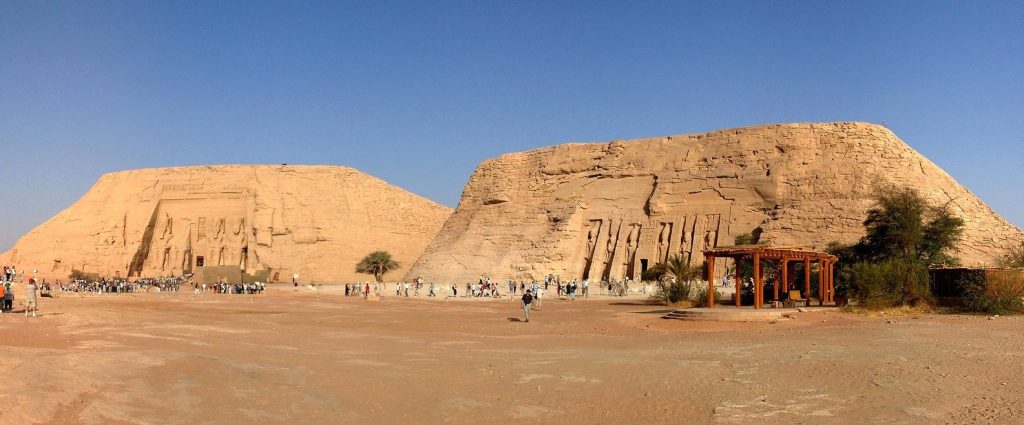
The complex consists of two temples carved directly into the sandstone mountainside. The Great Temple is dedicated to Ramses II alongside three major gods: Amun-Ra, Ra-Horakhty, and Ptah. The smaller temple was built to honor Queen Nefertari, his most beloved wife, and the goddess Hathor. Together, they form one of the most complete and well-preserved religious and political monuments from the ancient world.
Inside the Two Temples: What You Will Actually See
The Great Temple of Ramses II
The façade of the Great Temple of Ramses II is its most iconic feature: four seated colossal statues, each approximately 20 metres tall, flanking the entrance. One of the statues was damaged by an ancient earthquake, and its upper half lies at its base — a detail that somehow makes the site feel even more authentic and awe-inspiring.
Inside, the temple descends into the rock through a series of progressively smaller halls. The first is a grand hypostyle hall supported by eight Osiride pillars — statues of Ramses II in the pose of Osiris. The walls are covered in vivid reliefs depicting the Battle of Kadesh and various religious ceremonies, painted in colours that have survived more than three thousand years.
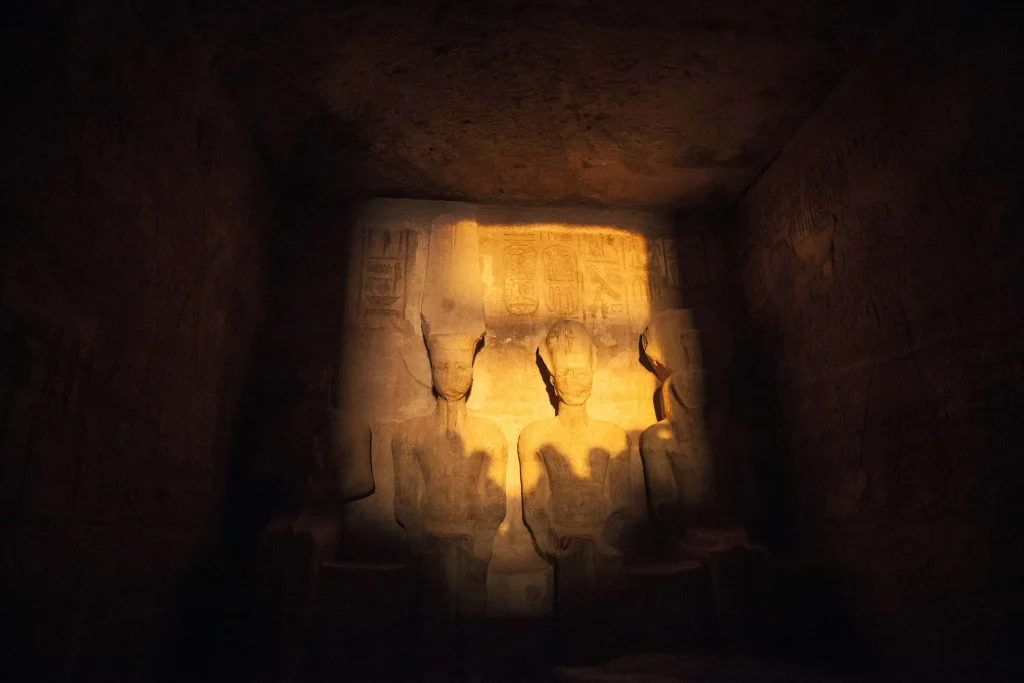
The innermost sanctuary contains four seated statues: Ramses II flanked by Amun-Ra, Ra-Horakhty, and Ptah. This chamber is the site of the famous solar alignment phenomenon, described in more detail below.
The Temple of Queen Nefertari
The smaller temple, dedicated to Queen Nefertari and the goddess Hathor, stands about 100 metres from the Great Temple. Though smaller in scale, it is no less impressive in its artistry. What makes it particularly unusual for ancient Egypt is that the statues of Nefertari on the facade are the same height as those of Ramses II — a rare expression of equality between royal husband and wife in ancient Egyptian monumental art.
The interior features a hypostyle hall with Hathor-headed pillars and walls decorated with scenes of offerings and religious rituals. For travelers interested in the role of women in ancient Egyptian culture, this temple offers a uniquely moving perspective.
The UNESCO Rescue: One of History’s Greatest Engineering Feats
The temples you see today are not in their original location. This fact, once absorbed, transforms the entire experience of visiting Abu Simbel.
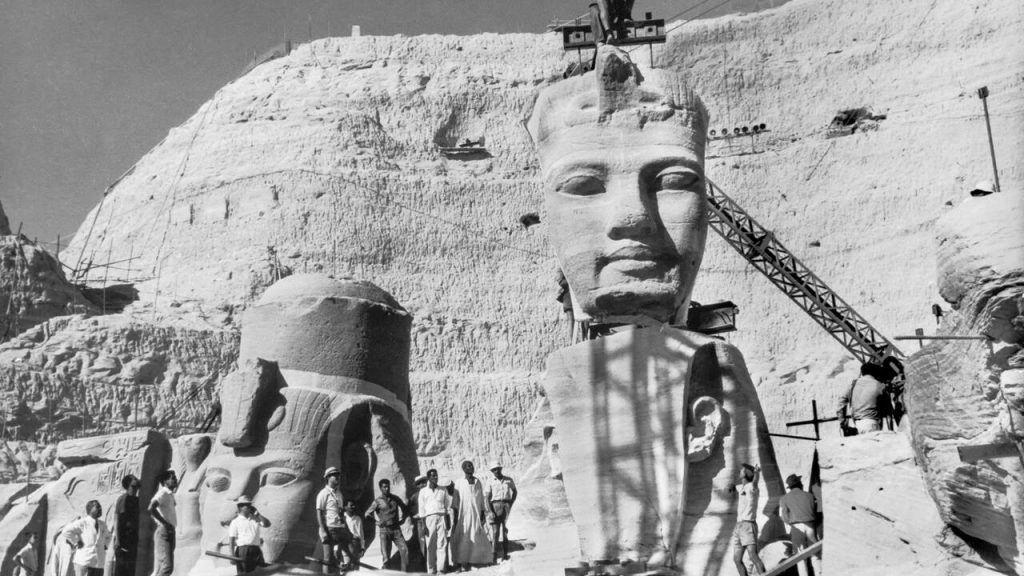
When Egypt built the Aswan High Dam in the 1960s, the rising waters of Lake Nasser threatened to permanently submerge dozens of ancient Nubian monuments. UNESCO coordinated an unprecedented international rescue campaign between 1964 and 1968. Abu Simbel was the centrepiece of that effort.
Engineers and archaeologists cut the two temples into more than 1,000 individual blocks, some weighing up to 30 tonnes each. The entire complex was then reassembled on an artificial hill 65 metres higher and 180 metres back from the original site. A concrete dome was built inside the hill to support the reconstructed temples from within. To preserve the famous solar alignment, engineers used survey data from the original site to orient the rebuilt temples at precisely the same angle relative to the sun.
The project cost approximately 40 million US dollars — funded by contributions from fifty countries — and is widely considered one of the most successful heritage conservation operations in human history. Twenty-two other Nubian monuments were also relocated or documented as part of the same campaign.
The Abu Simbel Sun Festival: A Once-in-a-Lifetime Event
Twice a year, on February 22nd and October 22nd, the rising sun penetrates the entire length of the Great Temple and illuminates three of the four statues in the innermost sanctuary. The fourth statue — representing Ptah, god of the underworld — remains in shadow even on these days, a detail believed to be intentional.
The dates correspond to the anniversary of Ramses II’s coronation and his birthday respectively. What is beyond debate is the astronomical precision required to engineer this alignment, and then to replicate it faithfully when the temple was relocated. Engineers reportedly adjusted the orientation by a single day when reassembling the temple, meaning the phenomenon now occurs one day later than it did in antiquity.
Thousands of visitors travel to Abu Simbel specifically for the Sun Festival, making accommodation in the nearby village very scarce around those dates. If this experience is on your list, book everything at least several months in advance.
How to Get from Aswan to Abu Simbel
Abu Simbel lies roughly 280 kilometres south of Aswan, close to the Sudanese border. Most visitors make the journey as a day trip from Aswan, though staying overnight in Abu Simbel village is possible and worth considering if you want a more relaxed experience.
By Organized Road Convoy
The most common option is traveling by road in a private or shared vehicle. Egyptian authorities historically required tourist vehicles to travel in organized convoys departing Aswan at set times — usually very early in the morning, around 3:00 or 4:00 AM. The convoy system has been relaxed in recent years, but it is worth confirming current requirements with your hotel or tour operator before you go. The journey takes approximately three to three and a half hours each way, following the western shore of Lake Nasser through desert scenery.
By Flight
Daily flights operate between Aswan Airport and Abu Simbel Airport, taking around 45 minutes. This is the fastest option and eliminates the long desert drive, though it is considerably more expensive than road travel. If your time in Egypt is limited and budget is not a concern, flying allows you to arrive refreshed and spend more time at the site itself.
By Lake Nasser Cruise
A smaller number of travelers arrive at Abu Simbel as part of a Lake Nasser cruise — a multi-day journey by boat that stops at several Nubian monuments along the way. This is arguably the most atmospheric way to approach Abu Simbel, arriving by water as ancient travelers would have done, though it requires significantly more planning and time.
Best Time to Visit Abu Simbel
Egypt’s southern climate is extreme, and Abu Simbel is no exception. Summer temperatures regularly exceed 45 degrees Celsius, making visits between June and August genuinely uncomfortable and potentially dangerous if you are not well-prepared.
The optimal window is October through April, when temperatures are far more manageable — typically between 20 and 30 degrees Celsius during the day. January and February can feel cool, especially in the mornings when most visitors arrive.
Arriving early in the morning is strongly recommended regardless of season: the site gets warm quickly once the sun is up, crowds build throughout the morning, and the quality of light for photography is better at dawn than at midday.
Practical Tips for Visiting Abu Simbel
- Carry at least 2 litres of water per person. There are vendors on site, but hydrating throughout the journey is important.
- Wear sunscreen, a hat, and light but covering clothing. The sun reflects off the pale sandstone intensely.
- Photography is permitted inside both temples, but flash is prohibited. A wide-angle lens helps in the narrow interior chambers.
- Do not touch the carvings or reliefs. The oils from skin cause long-term deterioration to ancient stone.
- Allow at least two to three hours on site — one hour is not enough to appreciate both temples properly.
- If you plan to stay overnight in Abu Simbel village, book accommodation well in advance, particularly around the Sun Festival dates in February and October.
- Entrance tickets must be purchased at the site. There is no option to book online in advance through official channels at the time of writing, though tour operators can handle ticketing as part of a package.
Combining Abu Simbel with Other Aswan Attractions
Most visitors spend at least two or three days in Aswan, which gives enough time to combine Abu Simbel with the city’s other significant historical sites. The region around Aswan is one of the densest concentrations of ancient Egyptian and Nubian heritage anywhere in the country.
Philae Temple, dedicated to the goddess Isis and relocated during the same UNESCO campaign as Abu Simbel, is one of the most beautiful temple complexes in Egypt and is easily reached by a short felucca or motorboat ride from Aswan. The Aswan High Dam and the older Low Dam nearby offer context for understanding the engineering decisions that necessitated the relocation of Abu Simbel. Kom Ombo Temple, roughly an hour north of Aswan by road or river, is a unique double temple dedicated to Sobek and Horus. Edfu Temple, further north, is one of the best-preserved temples in Egypt and can be combined with Kom Ombo in a single day trip.
A well-planned stay in Aswan of three to four days allows you to see all of these sites without feeling rushed, and to spend genuine time at each one rather than ticking boxes on a hurried tour.
Plan Your Aswan Day Tours
Ready to explore the region? These are our most popular guided tours departing from Aswan — each one designed to make the most of your time in Upper Egypt.
- → Tour to Abu Simbel Temple From Aswan — Round-trip transport, professional guide, and full access to both temples at one of the most iconic sites in the ancient world.
- → Day Trip to Kom Ombo and Edfu Temples From Aswan — Visit two of Egypt’s best-preserved temples in a single day, including the unique double temple at Kom Ombo and the magnificent Great Temple of Horus at Edfu.
- → Day Tour to Philae Temple & Aswan High Dam — Discover the island temple of Isis at Philae, relocated by UNESCO just like Abu Simbel, combined with a visit to the engineering marvel of the Aswan High Dam.
Is Abu Simbel Worth the Journey?
The honest answer is: yes, without reservation. The distance from Aswan is real, the early start is demanding, and the desert drive is long. But nothing quite prepares you for the scale of the Great Temple of Ramses II when you first see it — or for the quieter, more intimate experience of the Temple of Nefertari a short walk away.
What makes Abu Simbel different from most ancient sites is that it carries multiple layers of significance: the original achievement of Ramses II’s architects, the millennia of survival in the desert, and the extraordinary modern story of its rescue and reconstruction. Very few places in the world ask you to think simultaneously about 3,000-year-old history and 1960s engineering ingenuity. Abu Simbel does both.
If you are traveling in Upper Egypt, this is not a site to skip. Plan your visit carefully, go early, and give yourself enough time to absorb what you are seeing. The journey from Aswan to Abu Simbel is one of the most memorable in Egyptian travel — and the temples themselves fully justify every kilometre of it.


